

Understanding niyyah in rituals: sincerity explained
TL;DR:
- Niyyah is a sincere internal intention that grants spiritual validity and reward to acts of worship.
- Verbalizing niyyah is recommended for Hajj and Umrah but typically internal for other rituals.
- Proper niyyah is especially crucial when performing proxy Umrah, requiring clear naming and permission if applicable.
Many Muslims focus carefully on the outward steps of worship: the precise movements of prayer, the exact circuit count during Tawaf, or the correct sequence of Ihram before Umrah. Yet Islamic scholarship consistently teaches that these actions, however perfectly performed, carry no spiritual weight without one essential element: niyyah, or sincere intention. Niyyah is not a formality or a quick mental checkbox. It is the spiritual engine behind every act of worship, determining both its validity and its reward before Allah. This guide explains what niyyah truly means, how it applies across different rituals, and why it becomes especially significant when performing Umrah on behalf of someone else.
Table of Contents
- What is niyyah and why does it matter?
- How niyyah is expressed in different rituals
- Proxy Umrah: Niyyah requirements when performing for others
- Common mistakes and advanced insights about niyyah
- A fresh perspective: Why niyyah is more than a ritual prerequisite
- Ready to fulfill Umrah Badal with clarity?
- Frequently asked questions
Key Takeaways
| Point | Details |
|---|---|
| Niyyah is essential | Without sincere intention, rituals are not valid or rewarded in Islamic law. |
| Mostly internal | For most acts, niyyah is a matter of the heart and does not need to be spoken aloud. |
| Proxy acts have rules | When performing Umrah for others, niyyah must explicitly name the person and follow specific conditions. |
| Sincerity matters | Rituals performed to show off or with mixed intentions lose their spiritual benefit. |
| Practical steps clarify | Understanding the requirements helps you apply niyyah with confidence, whether for yourself or others. |
What is niyyah and why does it matter?
Niyyah comes from the Arabic root meaning “to intend” or “to aim.” In Islamic jurisprudence, it refers to the conscious, sincere resolve in the heart to perform an act of worship for the sake of Allah alone. It is not a spoken declaration or a written statement. It is an internal state of mind and heart that precedes and accompanies worship.
The theological foundation for niyyah is one of the most cited hadith in Islamic scholarship:
“Actions are judged by intentions, and every person will have what they intended.” (Sahih al-Bukhari, Sahih Muslim)
This hadith, narrated by Umar ibn al-Khattab, underpins the entire framework of Islamic worship. As scholars explain, niyyah in Islam is the dividing line between an act done as a spiritual duty and the same act done out of habit or social pressure.
Niyyah is the intention made in the heart before acts of worship, determining their validity and reward as per the hadith “Actions are judged by intentions.” This means that two people can perform the exact same prayer, fast the same number of days, or complete the same Tawaf circuits, yet receive vastly different rewards based solely on the sincerity and clarity of their intention.
Niyyah also serves a practical function: it differentiates between acts of worship and ordinary actions. Waking up early, for example, becomes an act of worship when accompanied by the intention to pray Fajr. Without that intention, it remains nothing more than an early morning habit.
Key reasons niyyah matters in Islamic worship:
- It determines whether an act is accepted as worship or dismissed as routine behavior.
- It distinguishes worship directed to Allah from actions performed for social recognition.
- It establishes the specific nature of the act (e.g., which prayer, which fast, which ritual).
- It connects the worshipper spiritually to the act, even before the physical performance begins.
- It is the basis for spiritual legitimacy in proxy Umrah and other forms of worship performed on behalf of others.
Pro Tip: Before beginning any act of worship, take a brief moment of stillness. Consciously remind yourself why you are performing this act and for whom. This simple pause is the practice of setting a sincere niyyah.
How niyyah is expressed in different rituals
Having understood the definition and spiritual weight of niyyah, it’s crucial to see how it’s actually carried out in different Islamic rituals. The rules vary slightly depending on the act of worship, and understanding these differences helps avoid common errors.

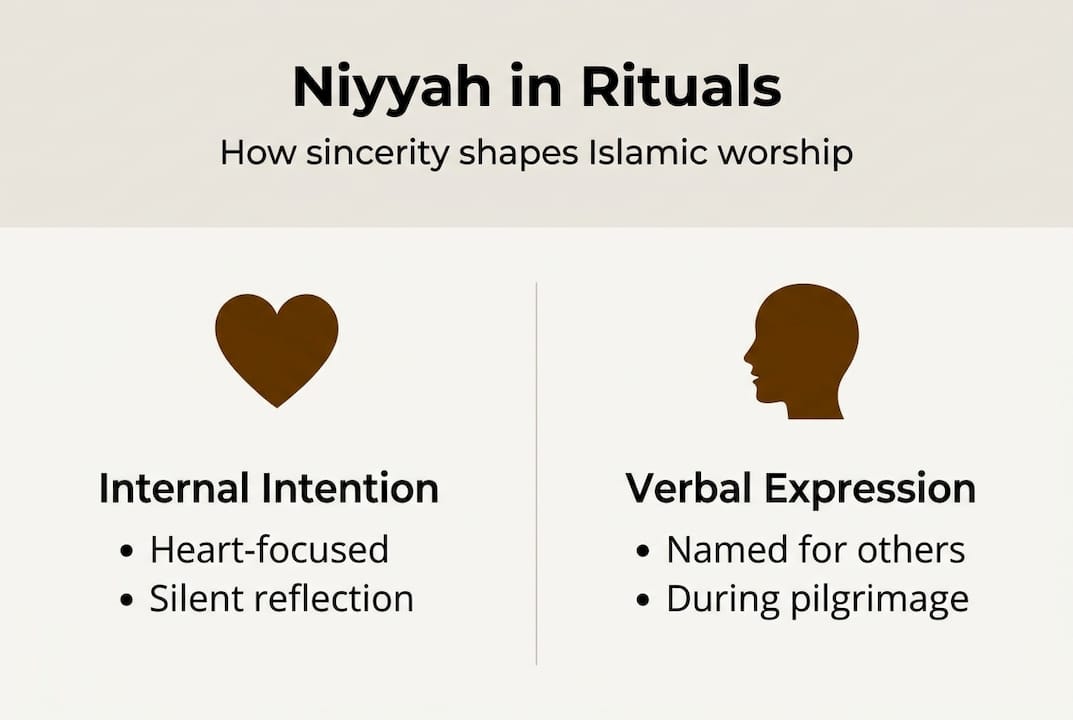
For most daily acts of worship, niyyah is entirely internal. Niyyah is internal to the heart and does not need to be verbalized, except when recommended for Hajj or Umrah. Sunni and Shia scholars broadly agree on this principle for most rituals. Speaking the intention aloud before prayer, for instance, is not a requirement in any major school of jurisprudence, though some scholars consider it permissible as a way to focus the mind.
For Hajj and Umrah, however, verbalizing the intention is recommended. The Talbiyah, which begins with “Labbayk Allahumma Labbayk,” serves partly as a verbal expression of the pilgrim’s intention to enter the state of Ihram. This verbal component is strongly encouraged, though the internal intention remains the binding element. You can find a useful overview on niyyah that covers these ritual-specific distinctions clearly.
| Ritual | Type of niyyah | Verbal expression |
|---|---|---|
| Salah (prayer) | Internal, in the heart | Not required |
| Sawm (fasting) | Internal, before Fajr | Not required |
| Wudu (ablution) | Internal | Not required |
| Zakat (charity) | Internal | Not required |
| Hajj or Umrah | Internal + verbal recommended | Strongly recommended |
| Proxy Umrah (Badal) | Internal, naming the person | Strongly recommended |
For more detailed rulings for proxy Umrah, including how intention interacts with the conditions of validity, it’s worth reviewing the relevant fiqh guidance.
Steps for forming a correct niyyah in worship:
- Clear your mind of distractions before beginning the act.
- Consciously identify the specific act of worship you are about to perform.
- Affirm in your heart that this act is solely for the sake of Allah.
- For Hajj or Umrah, verbalize the intention clearly, naming the ritual and, if applicable, the person on whose behalf it is performed.
- Begin the act immediately after forming the intention, without unnecessary delay.
Pro Tip: If you are unsure whether your niyyah was strong enough, renew it mentally at the start of each ritual segment. This is especially helpful during longer acts of worship like fasting or multi-day pilgrimage rites.
Proxy Umrah: Niyyah requirements when performing for others
Knowing the general approach to niyyah for rituals, the rules become more nuanced when performing acts like Umrah on behalf of others. Proxy Umrah, known as Umrah Badal, carries additional conditions that must be met for the act to be spiritually and legally valid.
For Umrah on behalf of others, the performer must first have completed their own Umrah, make a specific niyyah naming the person, and the act is permissible for deceased individuals or permanently incapacitated living persons with their permission. These conditions are not optional. They are foundational to the validity of the proxy act.
For a detailed walkthrough of Umrah for a deceased loved one, or a broader guide on performing Umrah on behalf of others, these resources address the specific conditions scholars have outlined.
| Aspect | Personal Umrah niyyah | Proxy Umrah niyyah |
|---|---|---|
| Who is named | Yourself | The person being represented |
| Prior requirement | None | Must have completed own Umrah |
| Permission needed | No | Yes, if person is living |
| Verbal declaration | Recommended | Strongly recommended |
| Eligible recipients | N/A | Deceased or permanently incapacitated |
Conditions for valid proxy Umrah niyyah:
- The proxy must have already performed Umrah for themselves at least once.
- The intention must specifically name the person being represented.
- If the person is living, their explicit permission is required.
- The proxy must perform all rites correctly, including Ihram, Tawaf, Sa’i, and Tahallul.
Step-by-step: how to declare niyyah for proxy Umrah:
- Enter the Miqat (the designated boundary for Ihram) with the clear intention of performing Umrah on behalf of the named person.
- Verbally state: “O Allah, I intend to perform Umrah on behalf of [person’s name], accept it from them.”
- Maintain this intention throughout all rites, from Tawaf to Sa’i to Tahallul.
- Make du’a (supplication) for the person throughout the ritual.
- Ensure all rites are completed without interruption or invalidation.
For further guidance on the proxy Umrah process, including common procedural questions, consulting a qualified Islamic scholar alongside practical resources is always advisable.
Common mistakes and advanced insights about niyyah
With the mechanics and requirements addressed, perfecting niyyah requires avoiding common spiritual pitfalls. Even sincere worshippers can fall into patterns that weaken or nullify the intention behind their worship.
The most serious error is riya, which means performing acts of worship to be seen or praised by others. The Quran directly addresses this in Surah Al-Ma’un (107:4 to 7), warning those who pray while being heedless of its meaning and who perform acts only for show. Mixed intentions or showing off reduce or nullify reward, and niyyah must be sincere and directed to Allah alone.
Common niyyah mistakes to avoid:
- Riya (showing off): Performing worship to gain social approval or admiration.
- Habitual mindlessness: Going through ritual motions without conscious intention, treating worship as routine.
- Combining incompatible intentions: Attempting to fulfill two distinct acts of worship with one niyyah when they are separate obligations.
- Delayed intention: Forming the niyyah after the act has already begun, which may invalidate the ritual depending on the school of jurisprudence.
- Vague intention: Being unclear about which specific act of worship you are performing.
For a deep dive on niyyah and how scholars address edge cases, including mixed motives, the scholarly literature is extensive and accessible.
One advanced and often overlooked insight is that ordinary, everyday actions can become acts of worship through sincere niyyah. Giving to charity, showing kindness to a neighbor, or even eating a meal with the intention of maintaining strength for worship all carry spiritual reward when accompanied by the right intention. This transforms the entire texture of a Muslim’s daily life. For those performing proxy worship, reviewing the Umrah Badal duties guide can help ensure every step is approached with the right mindset.
Pro Tip: If you notice your mind drifting toward thoughts of how others perceive your worship, pause and silently renew your intention. A brief, sincere renewal is spiritually valid and keeps the act directed toward Allah.
A fresh perspective: Why niyyah is more than a ritual prerequisite
After exploring the rules and pitfalls, it’s time to look at niyyah through a wider, more transformative lens. There is a tendency in religious education to reduce niyyah to a checklist item: say the right words, think the right thought, proceed with the ritual. This approach misses something essential.
Niyyah is not a gate you pass through to enter worship. It is the quality that runs through every moment of the act itself. A person performing proxy Umrah carries a profound responsibility. Their sincerity does not just affect their own reward. It shapes the spiritual value of an act performed on behalf of someone who cannot be there. That weight demands genuine mindfulness, not just technical compliance.
Focusing solely on the mechanics of niyyah risks turning worship into a legal exercise rather than a living connection with Allah. The rules exist to protect sincerity, not replace it. When you perform proxy faith fulfillment with full awareness of who you represent and why, the act carries a depth that no checklist can capture. True niyyah is ongoing, renewed, and rooted in love for Allah and compassion for the one being represented.
Ready to fulfill Umrah Badal with clarity?
Understanding niyyah is the first step. Applying it with confidence in a complete, valid proxy Umrah is the next.
At Badalumrah.org, we specialize in facilitating Umrah Badal with full religious compliance, transparent documentation, and personalized certificates so you can be confident every condition, including proper niyyah, is met. Whether you are honoring a deceased loved one or fulfilling a duty for someone unable to travel, our Umrah Badal Du’a package and Barakah Premium Package provide structured, trustworthy support. A portion of every booking also supports humanitarian efforts in Gaza, reflecting the same spirit of compassion that drives sincere worship.
Frequently asked questions
Do I have to say my niyyah out loud before rituals?
No. Niyyah is internal to the heart and does not need to be verbalized for most rituals. Verbal expression is only recommended, not required, for Hajj or Umrah.
Can I perform Umrah on behalf of a living person?
Yes, but only with their explicit permission and only if they are unable to perform it themselves due to illness or a permanent condition, as established in Umrah Badal rulings.
What if my intention is mixed or I want to impress others?
Mixed motives or riya reduce or completely nullify the reward of a ritual. Sincerity directed solely toward Allah is essential for an act of worship to be accepted.
How specific does my niyyah need to be for proxy Umrah?
The niyyah must clearly name the person on whose behalf you are performing Umrah, as naming the person is a required condition for the proxy act to be valid.
Can I combine two intentions in one ritual, like Duha and Sunnah prayers?
No. Distinct acts of worship each require their own separate niyyah. Combining distinct worship intentions is not valid and may invalidate one or both acts.