

Islamic rulings for performing Umrah on behalf of others
TL;DR:
- Islamic law permits performing Umrah on behalf of deceased or permanently incapacitated individuals through proxy (Umrah Badal).
- The proxy must be Muslim, of sound mind, have completed their own Umrah, and have explicit permission from living persons.
- The process involves completing one’s own Umrah, then entering ihram again to perform rites for the proxy with clear intention.
Many Muslim families carry a quiet, heavy question: can they fulfill the sacred rite of Umrah for a parent too frail to travel, or for a loved one who passed away before completing it? The uncertainty is real, and the emotional weight is significant. Islamic law, however, offers a clear and compassionate answer through the concept of Umrah Badal, or proxy Umrah. This guide walks through the religious foundations, eligibility requirements, step-by-step process, and key scholarly differences, so your family can act with confidence and sincerity.
Table of Contents
- The foundation: When is Umrah by proxy allowed?
- Eligibility: Who can be a proxy and for whom can Umrah be performed?
- Step-by-step: How proxy Umrah is performed
- Understanding key fiqh differences and common questions
- A fresh perspective: Why proxy Umrah matters now more than ever
- How we can help you fulfill Umrah Badal confidently
- Frequently asked questions
Key Takeaways
| Point | Details |
|---|---|
| When proxy Umrah is allowed | It is permitted for deceased Muslims or those with permanent incapacity due to health or age. |
| Eligibility of proxy | The proxy must be Muslim, sane, capable, and have performed their own obligatory Umrah or Hajj. |
| Process for each individual | A complete Umrah must be performed from start to finish for each individual, with specific intention at the miqat. |
| Shari’ah school nuances | While all Sunni schools accept Umrah Badal for the deceased, there are minor differences for the living incapacitates. |
| Modern implications | Proxy Umrah reflects Islam’s enduring mercy, adapting to help families fulfill obligations amid health challenges. |
The foundation: When is Umrah by proxy allowed?
Let’s clarify when Umrah on behalf of another person is permitted under Islamic law. Umrah Badal refers to performing the Umrah pilgrimage on behalf of someone else. This practice is not a modern innovation. It is grounded in authentic hadith and supported by scholarly consensus across the major Sunni schools of law.
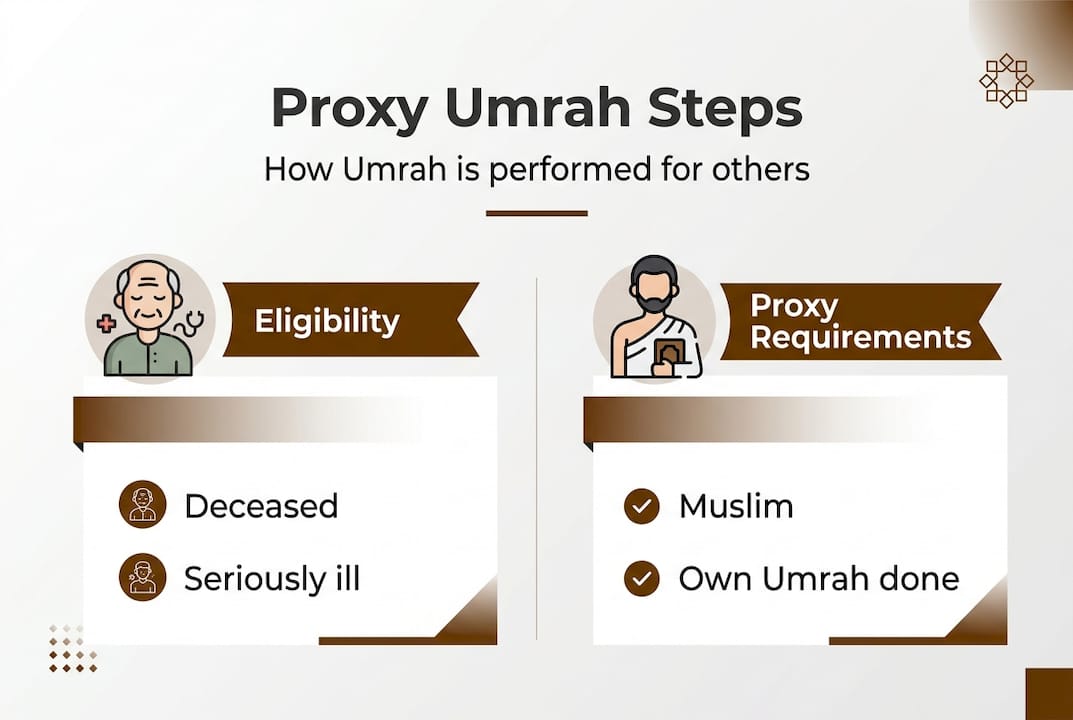
The Prophet Muhammad (peace be upon him) was asked about performing Hajj on behalf of a father who could not travel, and he affirmed its permissibility. Scholars extend this ruling to Umrah as well. The permissibility of Umrah Badal is established for deceased Muslims and for living Muslims who face a permanent medical incapacity or extreme old age that prevents travel.
Not every situation qualifies. Temporary illness, financial hardship alone, or personal preference do not make someone eligible to receive proxy Umrah. The incapacity must be genuine, lasting, and beyond reasonable hope of recovery.
“Scholars agree that proxy Umrah is valid for the deceased and for those with permanent inability to travel due to illness or old age. It is not permitted for those who simply choose not to travel.”
Here are the primary situations where Umrah Badal is permitted:
- Deceased Muslims who never performed Umrah or whose families wish to offer it as a gift of worship
- Elderly individuals who are physically incapable of undertaking the journey
- Chronically or permanently ill persons who have no realistic prospect of traveling to Makkah
- Individuals with severe disabilities that prevent safe travel and the performance of rites
One important condition applies to living persons: Umrah for others is allowed only with their explicit permission. A proxy cannot simply decide to perform Umrah for a living person without that person’s knowledge and consent. For the deceased, consent is not required, and the act is considered a gift of worship.
The special provisions for ill persons in Islamic law reflect a broader principle: religious duties are not meant to cause undue hardship. Islam provides pathways so that every believer, regardless of physical ability, can remain connected to acts of worship.
Eligibility: Who can be a proxy and for whom can Umrah be performed?
With foundational rulings clear, we need to know who may serve as a proxy and for whom this can be done. Not everyone is qualified to perform Umrah Badal, and understanding these requirements protects both the proxy and the person being represented.
According to Islamic rulings on Badal Umrah, the proxy must meet the following conditions:
- Must be Muslim and of sound mind
- Must have already completed their own obligatory Umrah or Hajj before performing it for someone else
- Must be physically capable of performing all the rites correctly
- Must have the intention (niyyah) to perform the rite specifically on behalf of the named individual
These conditions are not arbitrary. They ensure the proxy is spiritually prepared and that their own religious obligation is fulfilled first. A person who has never performed Umrah for themselves cannot validly perform it for another, according to the meaning of Badal Umrah in Islamic scholarship.
| Scenario | Proxy Umrah permitted? |
|---|---|
| Deceased parent who never performed Umrah | Yes, no consent needed |
| Elderly mother with permanent illness | Yes, with her consent |
| Chronically ill sibling unable to travel | Yes, with their consent |
| Healthy adult who simply prefers not to go | No |
| Person with temporary illness | No (wait for recovery) |
| Non-Muslim performing on behalf of Muslim | No |
The table above summarizes the most common family scenarios. As you can see, performing Umrah for someone else is a carefully defined act, not an open-ended option.
Pro Tip: If you are unsure whether your loved one’s condition qualifies, consult a trusted Islamic scholar before booking. A brief consultation can save doubt and ensure the act is spiritually valid.
What disqualifies a proxy? A non-Muslim cannot serve as proxy. Someone who has not yet fulfilled their own Umrah obligation is also disqualified. And performing Umrah for a living person without their consent is not valid.
Step-by-step: How proxy Umrah is performed
Knowing if and who can perform proxy Umrah leads us to the next step: how exactly it is carried out, from intention to completion.
The process follows a specific sequence. According to fiqh guidance on proxy Umrah, the proxy must first complete their own Umrah, then enter ihram again for the person on whose behalf they are performing.
Here is the full sequence:
- Complete your own Umrah first. Enter ihram at the miqat (the designated boundary point), make your own niyyah, perform Tawaf (circling the Kaaba seven times), Sa’i (walking between Safa and Marwa), and complete Tahallul (exiting ihram by shaving or cutting hair).
- Travel to Tan’eem (the nearest miqat point outside Makkah, also known as Masjid Aisha) to enter ihram for the proxy Umrah.
- State the niyyah clearly. Say: “O Allah, I intend to perform Umrah on behalf of [name], so accept it from them.” Naming the person and their relationship to you is recommended.
- Perform all Umrah rites in full: Tawaf, Sa’i, and Tahallul, all with the intention dedicated to the person you represent.
- Repeat the full process for each additional person. You cannot combine intentions for two people in a single Umrah.
“Each Umrah is a complete, independent act of worship. The proxy must renew ihram and intention separately for every individual they represent.”
The step-by-step Badal Umrah guide reinforces that no shortcuts exist in this process. Families sometimes ask whether a proxy can perform Umrah for three relatives in one trip. The answer is yes, but each Umrah requires its own ihram, niyyah, and complete set of rites.
| Rite | Location | Notes for proxy |
|---|---|---|
| Ihram | Tan’eem (for proxy rounds) | State name of recipient in niyyah |
| Tawaf | Masjid al-Haram | Seven circuits, full intention for recipient |
| Sa’i | Between Safa and Marwa | Seven lengths, maintain proxy intention |
| Tahallul | Makkah | Shave or cut hair to exit ihram |
Refer to the complete Badal Umrah process and the four pillars of Umrah guide for a deeper look at each rite and its requirements.
Understanding key fiqh differences and common questions
After walking through the practical process, families often face detailed questions and sometimes hear multiple opinions from scholars. Here we clarify the most important differences and answers.
All four major Sunni schools of law (Hanafi, Maliki, Shafi’i, and Hanbali) permit proxy Umrah for the deceased. They also broadly agree on allowing it for living persons with permanent incapacity. The main area of difference involves the Maliki school, which is more cautious about proxy Umrah for living persons and in some interpretations discourages it unless the incapacity is well established. According to scholarly analysis of proxy Umrah, all schools ultimately allow it, but the Maliki position requires stronger evidence of permanent inability.
Here are the most common concerns families raise:
- Can I combine intentions for two relatives in one Umrah? No. Each Umrah is for one person only. This is a point of consensus across all schools.
- What if I follow the Maliki school and my relative is elderly but not formally diagnosed? Consult a Maliki scholar. In practice, extreme old age that prevents travel is generally accepted as sufficient grounds.
- What if the proxy makes an error during rites? Minor errors can often be corrected on the spot. Significant errors, such as skipping a pillar of Umrah, may require repeating the rite. Standard Umrah correction rules apply.
- Can a woman perform proxy Umrah for a man, or vice versa? Yes. Gender does not restrict who can serve as proxy.
Pro Tip: If your family follows a specific school of law, seek guidance from a scholar within that tradition. The Badal Umrah full guide covers rulings across all four schools and can help you identify the most relevant position for your situation.
Families with relatives from different fiqh backgrounds sometimes worry about conflicting rulings. The practical advice is straightforward: follow the school your family adheres to, ensure the proxy meets all conditions, and perform the rites sincerely. The difference between Umrah Badal and normal Umrah is primarily one of intention and sequence, not the rites themselves.
A fresh perspective: Why proxy Umrah matters now more than ever
With clarity on variants and practical concerns, let’s reflect on the deeper wisdom behind proxy Umrah today. Many families approach this topic with anxiety, worried about making a mistake or acting outside the bounds of Islamic law. That caution is understandable and even admirable. But the scholarly consensus on proxy Umrah is rooted in mercy, not restriction.
We have seen how this process transforms families. A daughter performing Umrah for her bedridden mother does not just fulfill a religious duty. She strengthens a bond that illness and distance cannot break. An adult child performing Umrah for a deceased parent carries forward a love that transcends loss.
The special provisions for ill persons in Islamic law are a reminder that the faith was designed for real human lives, not ideal circumstances. Rigid interpretations often cause unnecessary distress. The truth is that Islamic law has always made room for compassion, and proxy Umrah is one of its most beautiful expressions. Do not let uncertainty stop your family from accessing this gift.
How we can help you fulfill Umrah Badal confidently
Our perspective is rooted in serving families just like yours. If you need support to ensure proxy Umrah is completed correctly and compassionately, we are here to help.

At badalumrah.org, we guide families through every step of the Umrah Badal process, from verifying eligibility to performing the rites with full documentation. Our packages include video and photo coverage, a personalized certificate, and ongoing support so you have complete peace of mind. Whether you are looking for the Barakah Premium package for a comprehensive experience or the Du’a Package for a more focused option, we have a solution for your family’s needs. Explore all our Umrah packages and take the next step with confidence.
Frequently asked questions
Can I perform Umrah for a living person without their consent?
No. A living person must give explicit consent for proxy Umrah to be valid. Consent is required for living persons, but it is not needed when performing Umrah for the deceased.
Can one Umrah suffice for several people if I make multiple intentions?
No. Islamic rulings are clear that each Umrah is for one person only. You must perform a separate, complete Umrah with a fresh ihram and niyyah for each individual.
What if the proxy makes a mistake performing rites?
Minor mistakes should be corrected according to standard Umrah guidance. Significant errors, such as omitting a pillar, may require repeating that part of the rite, as mistakes must be remedied under normal Umrah law.
Are there differences in rulings among Islamic schools about proxy Umrah?
Yes. All four schools permit proxy Umrah for the deceased, but the Maliki view on proxy Umrah is more restrictive for living persons, requiring stronger evidence of permanent incapacity compared to the other three schools.