

4 pillars of Umrah: complete guide and practical tips
Many Muslims arrive at the Miqat with sincere hearts but genuine uncertainty about which acts are truly essential to a valid Umrah. There is a meaningful difference between recommended acts (mustahabb) and the four pillars (arkaan) that form the backbone of the ritual. Skipping a recommended act does not break your Umrah. Skipping a pillar does. According to Islamic scholarship, the pillars of Umrah are four, and omitting any one of them invalidates the entire ritual. Whether you are preparing for your own Umrah or arranging it on behalf of a loved one, understanding these pillars is the first and most important step.
Table of Contents
Key Takeaways
| Point | Details |
|---|---|
| Four pillars critical | Ihram, Tawaf, Sa’i, and Halq/Taqsir are essential for a valid Umrah. |
| Omitting pillars invalidates | Missing any pillar means you must repeat all steps for the Umrah to count. |
| Proxy Umrah specific rules | Performing Umrah on behalf of others requires a special intention and prior completion of your own Umrah. |
| Distinction from Sunnah acts | Leaving out recommended acts does not invalidate Umrah, but missing a pillar does. |
What are the pillars of Umrah?
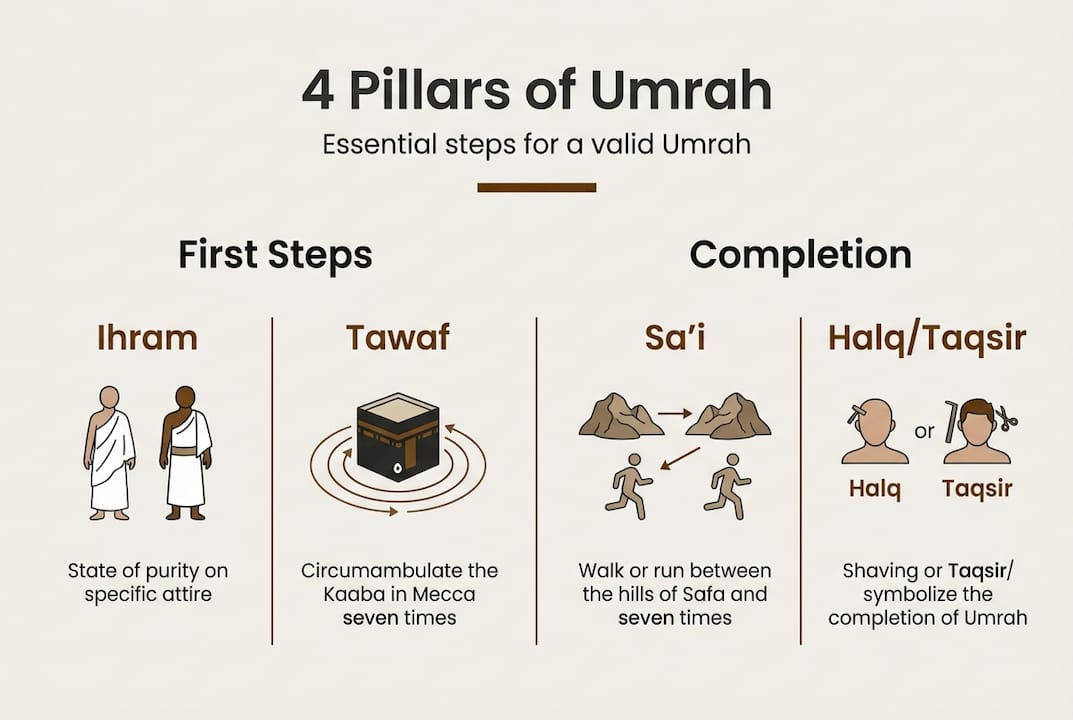
Let’s start by clarifying exactly which acts are fundamental to a valid Umrah. Islamic scholars agree that Umrah has four pillars: Ihram, Tawaf, Sa’i, and Halq or Taqsir. These are not optional. Every other act, such as reciting specific supplications or performing Raml during Tawaf, falls under Sunnah or recommended practice. Missing those does not affect validity. Missing a pillar does.
Here is a quick summary of the four pillars:
-
Ihram: Entering the sacred state with intention at the Miqat
-
Tawaf: Circling the Kaaba seven times counter-clockwise
-
Sa’i: Walking seven times between Safa and Marwah
-
Halq/Taqsir: Shaving or trimming the hair to exit Ihram
The table below shows how pillars differ from Sunnah acts:
| Act | Category | Effect if missed |
|---|---|---|
| Ihram with intention | Pillar | Umrah invalid |
| Tawaf (7 circuits) | Pillar | Umrah invalid |
| Sa’i (7 walks) | Pillar | Umrah invalid |
| Halq/Taqsir | Pillar | Umrah invalid |
| Raml during Tawaf | Sunnah | No effect on validity |
| Specific du’as | Recommended | No effect on validity |
Understanding the essential acts of Umrah helps you prepare with confidence. It also matters greatly when reviewing special provisions for ill persons who may need accommodations. For a full procedural walkthrough, the full Umrah steps provide detailed guidance.
Ihram: Intention and entering the sacred state
With an overview of the four pillars in mind, let’s explore each starting with Ihram. Ihram means entering a sacred state at the Miqat with a sincere intention for Umrah. It is not simply about wearing white garments. The intention (niyyah) is the heart of Ihram.
Here is how to enter Ihram correctly:
-
Perform ghusl (full body wash) before reaching the Miqat
-
Men wear two unstitched white garments (izar and rida); women wear modest, loose clothing
-
Make the niyyah verbally or in the heart: “I intend to perform Umrah”
-
Recite the Talbiyah: Labbayk Allahumma labbayk
-
Maintain the state of Ihram until Halq/Taqsir is complete
While in Ihram, certain acts are prohibited:
-
Cutting hair or nails
-
Using perfume or scented products
-
Engaging in marital relations
-
Covering the head (for men) or the face (for women, according to some scholars)
-
Hunting or harming animals
When performing Umrah on behalf of others, the niyyah must specifically name the person for whom the Umrah is being performed. For example: “I intend to perform Umrah on behalf of [name].” This is a critical requirement for Badal Umrah.
“The intention is the foundation of every act of worship. Without it, the act holds no spiritual weight.” — Classical Islamic principle
Pro Tip: If you are using a guided Umrah service, confirm in advance that the guide will prompt you through the niyyah correctly, especially for proxy Umrah.
A common mistake is making the intention too early, before reaching the Miqat boundary, or forgetting to verbalize it at all. Both can affect the validity of Ihram.
Tawaf: Circling the Kaaba
Once in Ihram, the next fundamental step is Tawaf. This involves walking seven complete circuits around the Kaaba in a counter-clockwise direction, starting and ending at the Black Stone (Hajar al-Aswad).
Follow these steps for a valid Tawaf:
-
Ensure you are in a state of wudu before beginning
-
Start at the Black Stone, facing it and saying “Bismillah, Allahu Akbar”
-
Complete seven full circuits, keeping the Kaaba on your left
-
Perform two rak’ahs of prayer at Maqam Ibrahim after completing Tawaf
-
Drink Zamzam water before proceeding to Sa’i
Wudu is required for Tawaf; men also perform Raml (a brisk, slightly hurried walk) during the first three circuits as a Sunnah act. Idtiba, which means uncovering the right shoulder, is also Sunnah for men. Neither affects validity if missed, but both carry spiritual reward.
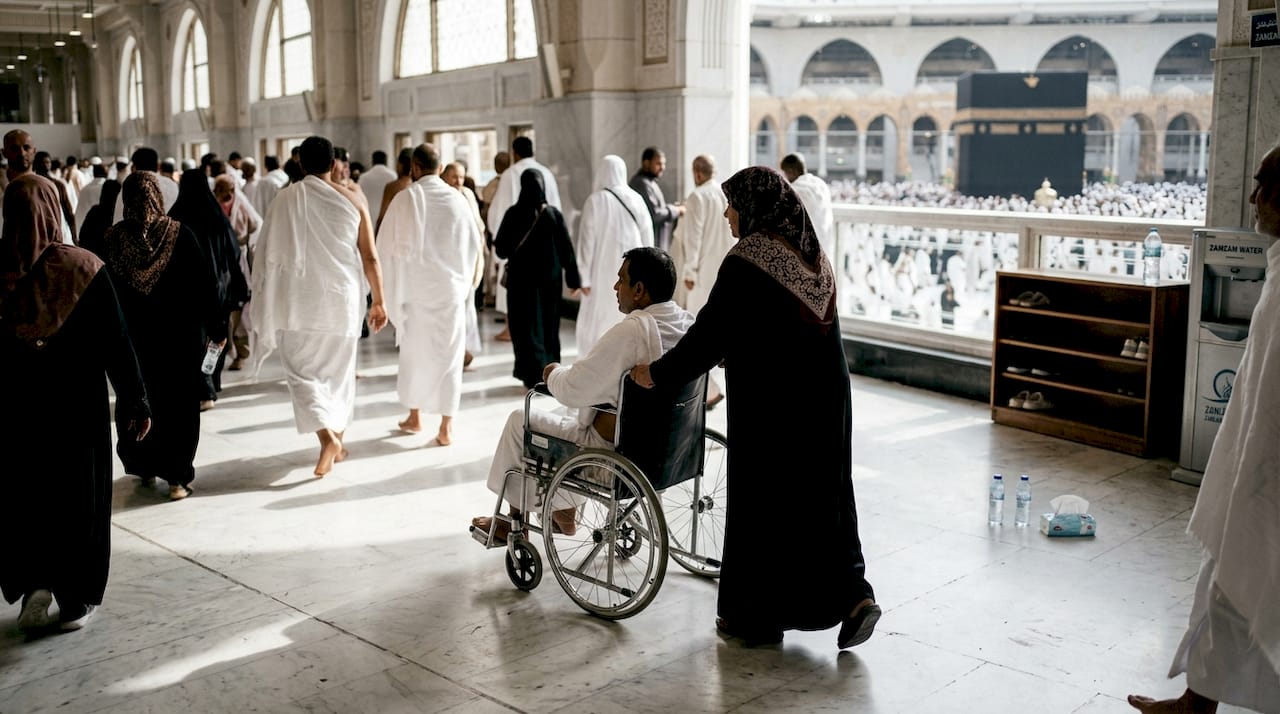
For those helping someone else complete Tawaf, such as pushing a wheelchair, the helper must also be in a state of wudu. Reviewing legitimate Umrah practices for families and caregivers can help you prepare for this scenario.
Pro Tip: The area closest to the Kaaba is the most crowded. If you or the person you are assisting has mobility concerns, performing Tawaf on the upper floors is valid and often more manageable.
Sa’i: Walking between Safa and Marwah
Following Tawaf, Sa’i forms the third essential step of Umrah. It commemorates the actions of Hajar, the wife of Prophet Ibrahim (peace be upon him), who ran between the hills of Safa and Marwah searching for water for her infant son Ismail. This act of faith and perseverance is now a permanent pillar of Umrah.
Here is how Sa’i is performed:
-
Begin at Safa, facing the Kaaba and making du’a
-
Walk toward Marwah (men jog lightly between the green markers)
-
Upon reaching Marwah, face the Kaaba and make du’a again
-
Return to Safa — this counts as two trips
-
Complete seven trips total, ending at Marwah
Sa’i follows Tawaf and must be done in sequence. Performing Sa’i before Tawaf is not valid. Wudu is preferred but not strictly required for Sa’i, unlike Tawaf.
“Sa’i is a reminder that sincere effort, even in moments of hardship, is an act of worship that Allah honors.”
For those with mobility limitations, wheelchairs and electric carts are available inside the Mas’a (the walkway between Safa and Marwah). If you are a caregiver or proxy, the tips for caregivers guide covers practical arrangements in detail.
Halq/Taqsir: Shaving or trimming the hair
After Sa’i, completing Umrah rests on one final pillar. Halq means shaving the entire head, while Taqsir means trimming a portion of the hair. This act marks the official end of Ihram and the lifting of all its restrictions.
Key rules for Halq/Taqsir:
-
Men may choose to shave the entire head (Halq) or trim at least one inch from all parts of the hair (Taqsir). Shaving is considered more virtuous.
-
Women trim only a small portion, approximately a fingertip’s length, from the ends of their hair. Shaving is not permitted for women.
-
Halq/Taqsir must be performed after Sa’i, not before.
-
Halq or Taqsir marks completion and the exit from Ihram. Once done, all Ihram restrictions are lifted.
-
If this step is omitted entirely, the Umrah is not complete and remains invalid.
Pro Tip: For Umrah hair-cutting guidance when performing on behalf of another person, the proxy performs Halq or Taqsir on their own hair, not the recipient’s. This is a common point of confusion.
What happens if a pillar is missed?
Understanding each pillar brings up a critical issue: what if one is overlooked? The ruling is clear across all major Islamic schools of thought. If a pillar is missed, the Umrah is invalid and must be repeated in full. There is no fidya (compensation) or sacrifice that can substitute for a missed pillar.
This is different from missing a Sunnah or recommended act:
| Type of act | Example | Consequence if missed |
|---|---|---|
| Pillar (rukn) | Tawaf, Sa’i | Umrah is invalid |
| Wajib (obligatory) | Staying in Ihram until Halq | May require fidya |
| Sunnah | Raml, Idtiba | No consequence |
| Recommended | Specific du’as | No consequence |
“The pillars of worship are not negotiable. They define the act itself. Without them, the act does not exist in the eyes of Islamic law.”
For those concerned about Umrah invalidation scenarios due to illness or disability, Islamic law does provide accommodations, but these apply to the manner of performing pillars, not to skipping them entirely.
Doing Umrah on behalf of others: Badal, rules, and intentions
Many people now wish to perform Umrah for others, and here is what you need to know. Umrah Badal (proxy Umrah) is permitted under specific conditions. Proxy Umrah is allowed for a deceased person or for a living person who is permanently incapacitated due to illness, old age, or disability.
Key rules for Umrah Badal:
-
The proxy must have already completed their own Umrah before performing it for someone else
-
The niyyah must clearly name the recipient: “I perform this Umrah on behalf of [name]”
-
Only one Umrah per person per trip is valid; you cannot combine proxies in a single journey
-
All four pillars must be completed in full, just as in a personal Umrah
-
The reward is conveyed to the recipient, while the proxy also receives spiritual benefit
For a deeper understanding of proxy Umrah requirements, including scholarly opinions, it is worth reviewing the rulings carefully. Those interested in combining worship with giving back can also explore humanitarian proxy Umrah initiatives. The concept of faith fulfillment by proxy reflects a beautiful dimension of Islamic communal responsibility.
Pro Tip: Always document the recipient’s full name and, if possible, their relationship to you before the journey. This helps ensure the niyyah is precise and the service is spiritually complete.
How to arrange Umrah Badal with trusted specialists
Ready to take the next step, whether for yourself or a loved one? Arranging Umrah Badal requires more than good intentions. It requires a trustworthy, Shariah-compliant process carried out by someone who understands both the spiritual and procedural requirements.
At badalumrah.org, every Umrah Badal is performed with full documentation, including photos, video coverage, and a personalized certificate, so you have complete peace of mind. The service is designed to be accessible for families worldwide, with clear booking steps and transparent communication throughout. You can explore the Umrah Badal Du’a package for a focused, sincere option, or consider the Barakah Premium package for a more comprehensive experience. The Noor package offers another thoughtful choice for those seeking a balance of value and spiritual care. Additionally, 10% of every booking supports humanitarian efforts in Gaza, making each Umrah an act of worship and compassion.
Frequently asked questions
Can I perform Umrah Badal for a living person?
Proxy Umrah is permitted if the recipient is permanently incapacitated due to illness, disability, or old age. For a healthy living person, it is primarily reserved for those who are genuinely unable to travel.
What happens if I miss one of the four pillars?
Missing any pillar invalidates the Umrah entirely, and it must be redone from the beginning. No compensation or sacrifice can substitute for a missed pillar.
Is wudu required for all Umrah pillars?
Wudu is required for Tawaf and highly recommended for Sa’i, but it is not strictly required for entering Ihram or performing Halq/Taqsir.
Can I perform two Umrahs in the same trip?
One Umrah per person per trip is the valid standard; you cannot combine proxy Umrahs or perform multiple Umrahs simultaneously for different recipients in a single journey.