

Islamic charity rules for Umrah: fulfilling duties clearly
TL;DR:
- Islamic charity rules specify strict guidelines for Zakat and Sadaqah, especially regarding funding Umrah.
- Zakat cannot generally be used to fund Umrah for others, but Sadaqah may support genuine needs.
- Performing Umrah on behalf of others is permissible with proper intention and conditions, but not typically funded by Zakat.
Many Muslims genuinely want to do right by their loved ones, especially when it comes to fulfilling religious duties like Umrah. But a surprisingly common belief holds that Zakat or Sadaqah can simply be used to fund Umrah for someone else, without any conditions. The reality is more nuanced. Islamic charity rules carry specific guidelines about who can give, who can receive, and what those funds can support. This guide walks through the essential rules so you can act with confidence, avoid common errors, and fulfill your religious obligations in a way that is both sincere and correct.
Table of Contents
- Understanding the basics: Zakat, Sadaqah, and Islamic charity types
- Who can receive charity? Recipients, exceptions, and special cases
- Umrah on behalf of others: What’s allowed and required?
- Can you fund Umrah with Zakat or Sadaqah? Common misconceptions explained
- A practical perspective: Balancing reward, duty, and impact
- Respecting Islamic guidelines with trusted Umrah facilitation
- Frequently asked questions
Key Takeaways
| Point | Details |
|---|---|
| Zakat is obligatory | Zakat is a mandatory charity paid annually if your wealth exceeds the nisab for a lunar year. |
| Sadaqah is flexible | Sadaqah can be given to almost anyone and at any time, including family members. |
| Strict Zakat rules for Umrah | Zakat cannot typically be used to fund Umrah or Hajj, except for rare cases involving non-dependents who are extremely poor. |
| Proxy Umrah requires care | You can only perform Umrah as a proxy after fulfilling your own and only for those permanently unable or deceased. |
| Prioritize real need | Islamic charity rules prioritize helping the poor over fulfilling rituals for others—real impact matters most. |
Understanding the basics: Zakat, Sadaqah, and Islamic charity types
Now that we’ve set the scene on common confusion, let’s clarify the core types of Islamic charity and how each one works.
Islamic charity is not a single concept. It covers several distinct categories, each with its own rules, recipients, and spiritual weight. Getting these straight is the foundation for everything else in this guide.
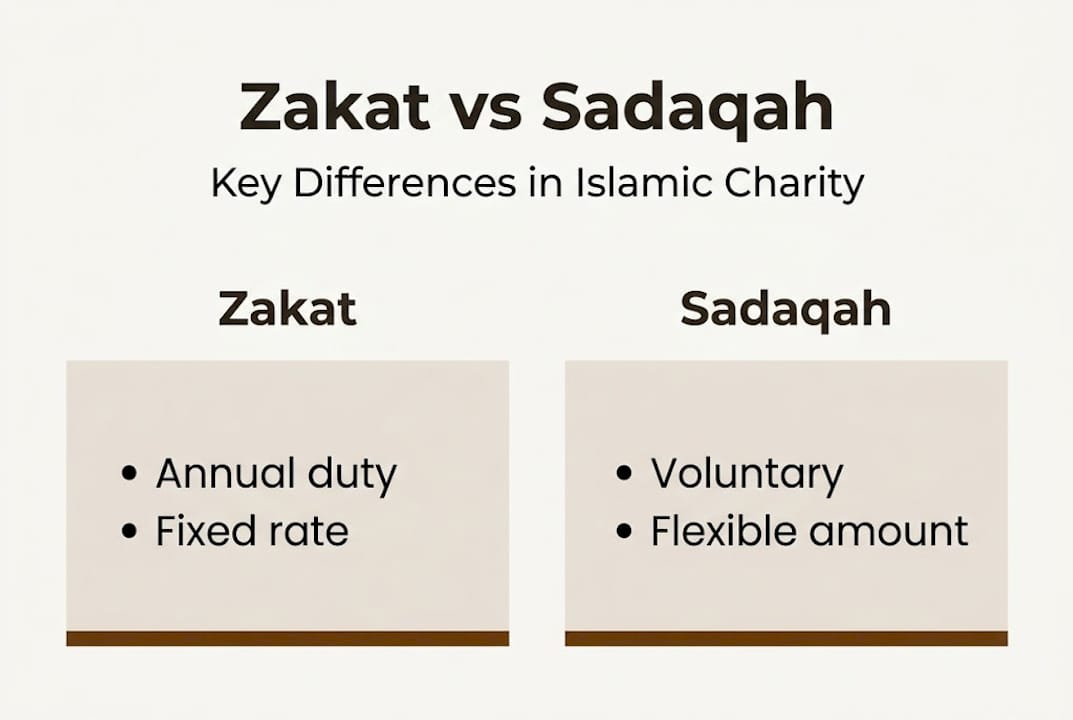
Zakat is the obligatory annual charity that every eligible Muslim must pay. It is calculated at 2.5% on wealth above nisab held for one full lunar year, and it applies to cash, gold, silver, business stock, and investments, with deductible liabilities subtracted first. The nisab is the minimum threshold of wealth a person must hold before Zakat becomes due.
Sadaqah, by contrast, is entirely voluntary. There is no fixed amount, no set schedule, and broader recipient eligibility compared to Zakat. You can give Sadaqah to almost anyone in need, including relatives, neighbors, or causes you care about.
Here is a quick comparison of the two:
| Feature | Zakat | Sadaqah |
|---|---|---|
| Obligatory? | Yes | No |
| Fixed rate? | 2.5% | No fixed amount |
| Specific recipients? | Yes (eight categories) | Flexible |
| Can fund Umrah? | Generally no | Sometimes, with conditions |
| Excludes dependents? | Yes | No |
Other charity types include Zakat al-Fitr (paid at the end of Ramadan), Waqf (endowment), and Kaffarah (expiation). These each serve distinct purposes and are governed by separate rules.
Key conditions that affect whether Zakat is due include:
- Wealth must exceed the nisab threshold
- It must be held for one complete lunar year (hawl)
- The owner must be a free, adult Muslim
- Liabilities such as debts can be deducted before calculating
Before giving, review your donation checklist for Muslims to make sure your charity is correctly calculated and directed.
Statistic callout: Zakat is fixed at 2.5% of eligible wealth annually. In 2026, the nisab based on gold is approximately 87.48 grams, making it essential to verify current gold prices before calculating your obligation.
Pro Tip: Always check current nisab values before calculating your Zakat, as gold and silver prices fluctuate throughout the year and can affect whether you are liable.
Who can receive charity? Recipients, exceptions, and special cases
With the basics understood, it’s important to see exactly who can receive charity and the key exceptions every donor should know.
Islamic law is precise about who may receive Zakat. The Quran identifies eight Zakat recipients: the poor (fuqara), the needy (masakin), Zakat collectors, those whose hearts are to be reconciled, those being freed from slavery, debtors, those in the cause of Allah (fi sabilillah), and stranded travelers (ibn al-sabil).
However, several important exclusions apply:
- Dependents of the donor cannot receive Zakat, including spouses, children, and parents.
- Syeds (descendants of the Prophet Muhammad, peace be upon him) are traditionally excluded from receiving Zakat in the majority Sunni view.
- Non-Muslims are generally excluded from Zakat under the majority scholarly opinion, though they may receive Sadaqah.
- Wealthy individuals who meet or exceed the nisab threshold are not eligible.
- Banu Hashim (the Prophet’s family clan) are excluded in the Sunni tradition.
Sadaqah is far more flexible. It can go to relatives, non-Muslims, animals, and even be given as a public benefit such as building a well or planting a tree.
“The majority of scholars prioritize giving Zakat to the poor and needy above funding ritual acts such as Hajj or Umrah, even when fi sabilillah is cited as a justification.”
Regarding minority scholarly views, Shia scholars differ on both the items subject to Zakat and its eligible recipients. Some minority opinions within various traditions also allow giving Zakat to non-Muslims when no eligible Muslim recipients are available in a given area.
Understanding these distinctions matters deeply when you are thinking about social responsibility in Umrah and how charitable acts connect to broader humanitarian duties. Those looking to support humanitarian efforts through Umrah will find that directing Sadaqah toward genuine need is often the most rewarded path.

Umrah on behalf of others: What’s allowed and required?
Next, understanding how charity rules intersect specifically with Umrah for others is key.
Performing Umrah on behalf of another person is known as Badal Umrah or proxy Umrah. Islamic scholars have established clear conditions for when this is valid and who may perform it.
According to established rulings, proxy Umrah is permissible for a person who has passed away or who is permanently incapacitated due to illness or disability. The proxy must have already performed their own Umrah before performing it on behalf of someone else.
Key conditions for valid proxy Umrah:
- The proxy must be a Muslim who has already fulfilled their own Umrah obligation
- The beneficiary must be deceased, or permanently unable to perform Umrah themselves
- Temporary illnesses do not qualify for proxy Umrah; the incapacity must be permanent
- One proxy Umrah covers one beneficiary only; separate performances are needed for multiple individuals
- The niyyah (intention) must be clearly stated at the start, naming the beneficiary
How to make the niyyah correctly:
- Enter the state of Ihram (ritual purity and garment) with the intention for the beneficiary
- State clearly: “Labbaik Umratan an [name of beneficiary]” (I respond to Your call performing Umrah on behalf of [name])
- Complete all Umrah rites, including Tawaf (circumambulation of the Kaaba), Sa’i (walking between Safa and Marwa), and Tahallul (exiting Ihram by shaving or cutting hair)
- The reward is directed to the named person; the proxy also receives reward for the act
For a thorough understanding of how Umrah on behalf of others works, including step-by-step guidance, it is worth reviewing detailed resources before arranging anything. Questions about whether Umrah for others is allowed are also addressed in dedicated scholarly discussions. Those with elderly or ill family members should also read about special provisions for ill persons within Umrah rites.
Pro Tip: Always seek guidance from a trusted Islamic scholar or a reliable organization before arranging proxy Umrah to ensure every condition is properly met.
Can you fund Umrah with Zakat or Sadaqah? Common misconceptions explained
Having explained the rules around proxy Umrah, let’s tackle one of the most persistent questions: can you actually use your Zakat or Sadaqah to help someone else perform Umrah?
The short answer for Zakat is: generally, no. The majority scholarly position is that Zakat cannot be used to fund Hajj or Umrah for others. The category of fi sabilillah, which some interpret broadly, is understood by most classical scholars to refer specifically to jihad or other direct acts of worship, not pilgrimage funding.
A minority scholarly view does allow using Zakat for pilgrimage in very limited cases, such as when the recipient is genuinely poor and there are no other needy Muslims to support. Even then, sending a family member or dependent on Hajj or Umrah using Zakat is not permitted under any mainstream position.
Here is a summary of the ruling consensus:
| Use of funds | Zakat | Sadaqah |
|---|---|---|
| Funding Umrah for the poor (non-family) | Minority allows | Generally allowed |
| Funding Umrah for a dependent | Not permitted | Not recommended |
| Funding Umrah for a deceased person | Not permitted | Allowed |
| Direct relief for the needy | Strongly recommended | Strongly recommended |
| Supporting humanitarian causes | Not typically valid | Fully valid |
Sadaqah carries more flexibility. You may use Sadaqah to support someone’s Umrah, particularly if they are in genuine need. However, scholars consistently advise that direct relief for the poor, feeding the hungry, or supporting urgent needs yields greater reward than funding ritual travel.
Key points to remember:
- Zakat has strict recipient categories; pilgrimage is not among them in the majority view
- Sadaqah is broader but should still prioritize genuine need
- Funding a family member’s Umrah from Zakat is not valid under any mainstream ruling
- Consulting Islamic pilgrimage and Umrah rules helps avoid costly mistakes
- For detailed scholarly guidance, review Islamic rulings for proxy Umrah before making any financial decisions
Statistic callout: Zakat is obligatory at 2.5% on eligible wealth. With strict recipient categories defined by Quranic verse, the majority of scholars agree that funding Umrah does not fall within valid Zakat uses.
A practical perspective: Balancing reward, duty, and impact
Bringing these rules together, let’s reflect on why they matter and how their true spirit shapes our charitable choices.
There is a real tension many Muslims face: the desire to honor a loved one through a spiritual act like Umrah, and the Islamic principle that charity should reach those in greatest need first. The rules around Zakat are not bureaucratic restrictions. They exist to protect the most vulnerable members of the community.
The uncomfortable truth is that some people focus on ritual acts because they feel more meaningful or visible, while urgent material needs go unmet. Islam’s charity framework pushes back against this tendency. When your Sadaqah feeds a family or relieves a debt, that act may carry more weight than funding a pilgrimage for someone who is not in desperate need.
This does not diminish the value of Badal Umrah. It is a deeply rewarding act when performed correctly and for the right reasons. But intention matters. Charity given to check a box is not the same as charity given with genuine concern for impact.
For those exploring how humanitarian acts in Islam connect to proxy Umrah duties, the relationship between mercy, obligation, and spiritual reward becomes clearer.
Pro Tip: When unsure how to direct your charity, consult a trusted scholar or a reputable Islamic organization. They can help you maximize both religious compliance and real-world impact.
Respecting Islamic guidelines with trusted Umrah facilitation
If you’re considering facilitating Umrah for a loved one in line with the rules explored, here’s how you can do so respectfully and efficiently.
At Badal Umrah, every arrangement is built around proper religious compliance, clear intention, and verified ritual completion. Whether you choose the Umrah Badal Du’a Package for a sincere and documented performance, or the Umrah Badal Barakah Premium for full video, photo, and certificate coverage, each package is designed to honor the conditions scholars require.

The process is straightforward, accessible worldwide, and guided by Islamic rulings at every step. A portion of profits also supports humanitarian efforts in Gaza, connecting your act of worship to broader compassion. This is a trustworthy way to fulfill a meaningful religious duty with clarity and peace of mind.
Frequently asked questions
What is the minimum wealth (nisab) for Zakat in 2026?
The nisab is 87.48 grams of gold or its silver equivalent, held for one full lunar year. Based on current gold prices, this is approximately $12,635, though you should verify the current nisab value before calculating.
Can Sadaqah be given to family members?
Yes, Sadaqah can be given to relatives and even dependents. Unlike Zakat, Sadaqah’s recipient rules are flexible and include family members, neighbors, and non-Muslims.
Is Zakat valid if I pay it later than when due?
Yes, missed Zakat remains an obligation and must be paid when possible. According to Shia and Sunni scholars alike, delaying Zakat does not cancel the debt owed.
Can Zakat fund Umrah for someone unable to go themselves?
No, Zakat generally cannot fund Umrah or Hajj. The majority scholarly ruling is clear that pilgrimage funding is not a valid Zakat use, with only a rare minority view allowing it for the truly poor who are not family members.
What intention (niyyah) is required for proxy Umrah?
The proxy must clearly intend to perform Umrah on behalf of the named person, stating their name at the start of the ritual. The correct formula is “Labbaik Umratan an [name],” announced at the point of entering Ihram.