

Why Umrah rites include special provisions for ill persons
Many Muslims worry that illness or old age prevents them or their loved ones from performing Umrah, one of Islam’s most spiritually rewarding acts of worship. This concern weighs heavily on families caring for elderly parents or chronically ill relatives who long to fulfill this sacred journey. However, Islamic teachings provide special rites and concessions specifically designed to ease these burdens while maintaining the validity and spiritual merit of the worship. These provisions reflect the religion’s core principle of mercy and its recognition that Allah does not burden any soul beyond its capacity. This article explains why these accommodations exist, how they work within Islamic jurisprudence, and the practical steps families can take to help their loved ones fulfill Umrah obligations despite physical limitations.
Table of Contents
- Key takeaways
- Understanding why special rites exist for ill and elderly pilgrims
- The role and rules of proxy Umrah (Umrah Badal) for incapacitated persons
- Facilities and support for ill and elderly pilgrims in Saudi Arabia
- How to fulfill Umrah obligations for ill family members: practical steps and trusted services
- Explore verified Umrah Badal packages and caregiver support
- FAQ
Key Takeaways
| Point | Details |
|---|---|
| Rukhsah for ill and elderly | Islamic law provides concessions to ease Umrah for ill or elderly pilgrims while preserving the ritual’s validity and reward. |
| Proxy Umrah option | Proxy Umrah, known as Badal Umrah, is allowed for permanently incapacitated living persons. |
| Accessible facilities in Saudi Arabia | The country provides accessible facilities and services to support ill and elderly pilgrims during Umrah. |
| Caregiver verified services | Caregivers should use verified services and packages tailored to special needs to ensure safe and respectful Umrah experience. |
Understanding why special rites exist for ill and elderly pilgrims
The foundation for accommodating ill and elderly pilgrims during Umrah rests on explicit Quranic guidance and the Prophet’s teachings about mercy in worship. The Quran clearly states that Allah does not burden a soul beyond its capacity (2:286), establishing the principle that religious obligations must remain achievable even when circumstances change. This verse provides the scriptural basis for what Islamic scholars call rukhsah, or divinely permitted concessions that ease worship without diminishing its validity or reward.
Mercy stands as a core Islamic value that directly shapes how worship accommodates human limitations. The Prophet Muhammad emphasized this repeatedly, teaching that religion should be easy, not burdensome, and that Allah loves when His servants accept the concessions He provides. These teachings led scholars across all four major schools of Islamic jurisprudence to develop detailed frameworks for how ill, elderly, or disabled pilgrims can perform Umrah while honoring both the ritual’s requirements and their physical constraints.
The rukhsah for Umrah includes several practical accommodations:
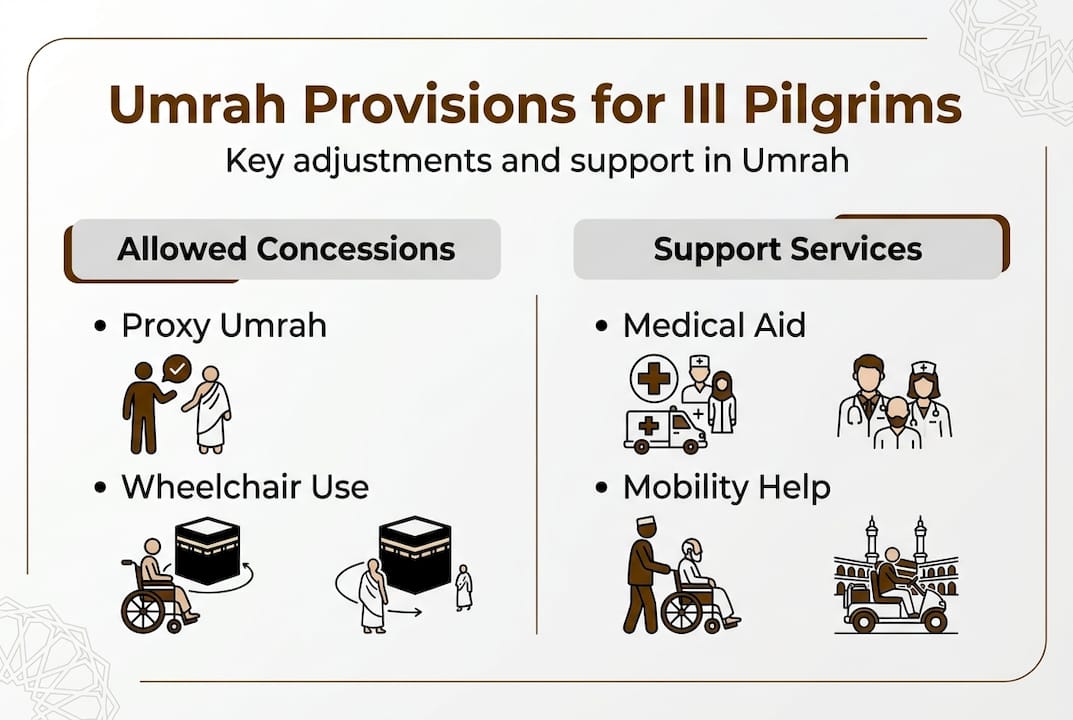
- Using wheelchairs or mobility aids during Tawaf and Sa’i without invalidating the ritual
- Taking necessary medications while in the state of Ihram
- Resting between ritual components for extended periods when needed
- Performing Tawaf in outer circles where crowds are thinner and movement easier
- Delegating certain physical tasks to caregivers while maintaining the pilgrim’s intention and presence
These concessions maintain worship validity while recognizing that physical hardship should not become a barrier to spiritual fulfillment. Scholar consensus across madhahib supports these adaptations, with detailed rulings addressing specific scenarios ill pilgrims might encounter. The Islamic rulings on Badal Umrah provide comprehensive guidance on when personal performance with accommodations is appropriate versus when appointing a proxy becomes necessary.
“The concessions Allah provides are gifts of mercy, and refusing them when needed shows misunderstanding of His wisdom and compassion.” This principle from classical Islamic scholarship reminds us that accepting accommodations demonstrates proper understanding of religious teachings, not weakness of faith.
The existence of these special rites reflects Islam’s practical approach to worship. Rather than creating impossible standards that exclude those facing physical challenges, the religion builds flexibility into its very structure. This approach ensures that spiritual obligations remain accessible throughout life’s changing circumstances, from youth through old age, in health and in illness.
The role and rules of proxy Umrah (Umrah Badal) for incapacitated persons
Proxy Umrah, known as Umrah Badal, represents a distinct solution for Muslims who face permanent incapacity that prevents them from traveling to Makkah or performing the physical rituals even with accommodations. This practice allows a qualified person to perform Umrah on behalf of someone else, but Islamic jurisprudence establishes strict conditions to ensure the practice remains valid and spiritually meaningful.
The fundamental requirement for proxy Umrah eligibility is permanent incapacity. Proxy Umrah applies only to individuals suffering from chronic illness, severe disability, or extreme old age that makes travel or ritual performance impossible. Temporary illness, pregnancy, or simply being too busy with work or family obligations do not qualify someone for proxy representation. This distinction matters because Islam requires able Muslims to perform Umrah personally when possible, reserving proxy as a compassionate exception for genuine inability.
The proxy must meet specific qualifications and perform the rituals with proper intention. Most importantly, the proxy declares the niyyah (intention) by saying “Labbaik Umrah’an 'an [Name of the person]” at the Miqat, clearly stating they are performing this Umrah on behalf of the incapacitated person. This verbal declaration transforms the proxy’s actions into worship credited to another person rather than themselves.
The madhahib (schools of Islamic jurisprudence) differ on certain proxy requirements:
- Shafi’i and Hanbali madhahib require the proxy to have already performed their own obligatory Umrah before performing one for someone else
- Hanafi madhhab does not require the proxy to have completed their own Umrah first, allowing greater flexibility
- Maliki madhhab generally restricts proxy Umrah to deceased persons only, with limited exceptions for the living
- All madhahib agree the proxy must be Muslim, of sound mind, and physically capable of completing the rituals
| Madhhab | Proxy for Living | Proxy Must Complete Own Umrah First | Additional Conditions |
|---|---|---|---|
| Hanafi | Yes, if permanently incapacitated | No | Proxy must be Muslim and capable |
| Maliki | Generally no, deceased only | Yes | Very limited exceptions for living |
| Shafi’i | Yes, if permanently incapacitated | Yes | Strict permanent incapacity required |
| Hanbali | Yes, if permanently incapacitated | Yes | Clear inability to travel needed |
The proxy must complete all Umrah components with the designated intention maintained throughout. This includes Ihram, Tawaf around the Kaaba seven times, Sa’i between Safa and Marwah, and the final Tahallul (exiting Ihram state). Each action performed by the proxy counts as if performed by the person they represent, provided the intention remains pure and the rituals follow proper procedure.
Pro Tip: Always verify your proxy’s credibility, religious knowledge, and sincerity before appointing them. Request documentation of their Umrah completion, references from their community, and clear communication about the niyyah they will make on your loved one’s behalf.
Families considering proxy Umrah should understand that Umrah for others is allowed only under these specific conditions. The guide to booking substitute Umrah walks through the process step by step, while Umrah preparation tips for families help caregivers make informed decisions about whether proxy or accompanied travel better serves their loved one’s situation.
Facilities and support for ill and elderly pilgrims in Saudi Arabia
Saudi Arabia has invested heavily in infrastructure and services that enable ill and elderly pilgrims to perform Umrah with dignity and relative ease. These accommodations transform what might seem impossible into achievable worship for millions of Muslims facing mobility challenges or health concerns.
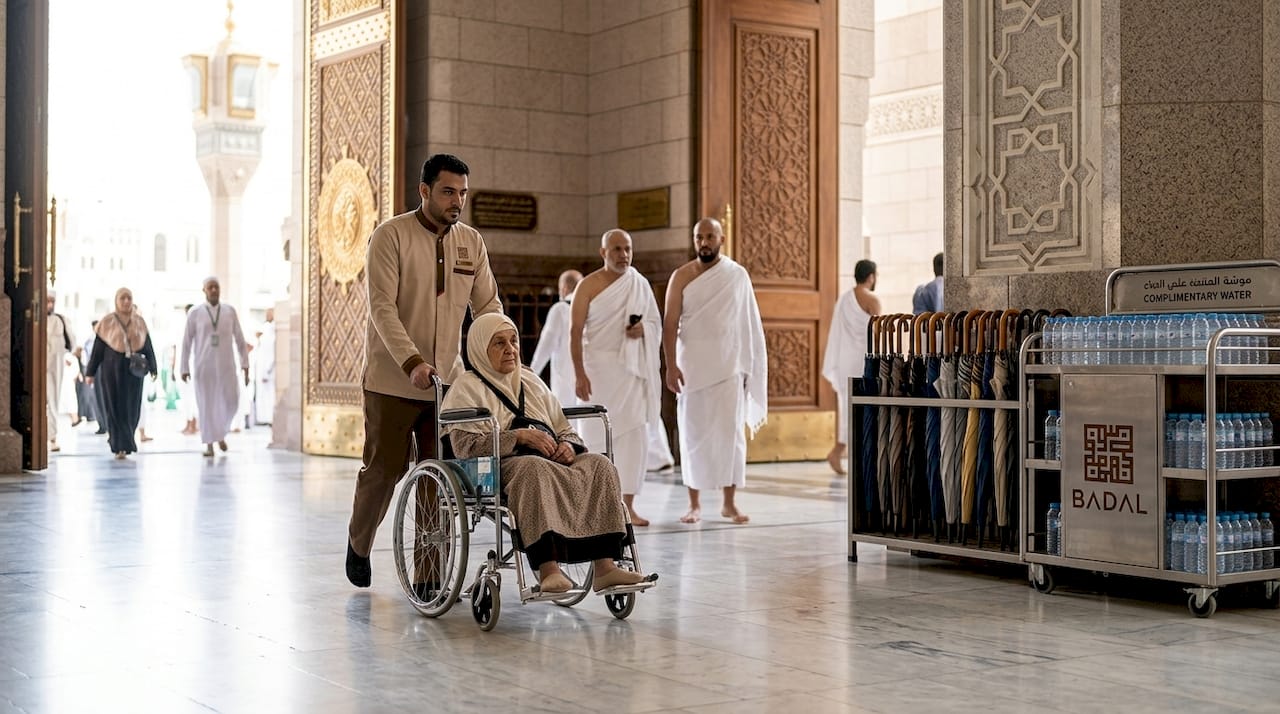
The Saudi government provides free wheelchairs, ramps, and electric carts at all major entry points and throughout the Haram areas. Pilgrims can access wheelchairs at airports immediately upon arrival and at designated stations near the Grand Mosque entrances. Electric carts operate continuously to transport those who cannot walk long distances between their accommodations and the Haram. These services require no advance booking or payment, reflecting the kingdom’s commitment to facilitating worship for all Muslims regardless of physical ability.
Accessibility features extend throughout the ritual spaces:
- Ramps and elevators provide wheelchair access to all levels of the Grand Mosque
- Designated Tawaf areas accommodate wheelchairs with wider pathways and controlled crowd flow
- Priority lanes expedite security checks and entry for disabled and elderly pilgrims
- Air-conditioned corridors connect parking areas to the Haram, protecting vulnerable pilgrims from extreme heat
- Medical stations staffed with healthcare professionals stand ready throughout the Haram complex
Since 2025, Saudi Arabia has eliminated upper age limits for Umrah visas, recognizing that spiritual readiness matters more than chronological age. However, pilgrims with severe medical conditions must provide health certificates confirming they can safely undertake the journey. This policy balances accessibility with safety, ensuring elderly pilgrims can fulfill their religious obligations without putting their health at unacceptable risk.
Specialized service providers have emerged to support pilgrims with special needs. Hotels near the Haram now offer accessible rooms with grab bars, wider doorways, and emergency call systems. Transport companies provide vehicles with hydraulic lifts and medical equipment storage. Many travel agencies design packages specifically for elderly and disabled pilgrims, including services like:
- Personal attendants who assist with mobility and ritual performance
- Medical professionals traveling with the group
- Flexible schedules allowing extra rest between ritual components
- Accommodations closest to the Haram to minimize walking distances
- Pre-arranged wheelchair access and priority entry permissions
The Umrah tips for caregivers explain how to maximize these resources, while guided Umrah services offer comprehensive support packages that handle logistics so families can focus on worship.
Pro Tip: Inform your travel agent about specific medical needs and mobility limitations at least two months before departure. This advance notice allows them to secure appropriate accommodations, arrange medical equipment, and coordinate with Saudi facilities to ensure seamless support throughout your journey.
These extensive facilities mean many pilgrims who initially consider themselves too ill or elderly to travel can actually perform Umrah personally with proper planning and support. The infrastructure removes many barriers that once made the journey impossible for those with physical limitations.
How to fulfill Umrah obligations for ill family members: practical steps and trusted services
Families caring for ill or elderly relatives who wish to perform Umrah face an important decision: should their loved one travel with accommodations and support, or should they appoint a trusted proxy to perform Umrah on their behalf? This choice requires careful assessment of the person’s physical condition, medical prognosis, and personal wishes.
Begin by confirming whether your family member qualifies for proxy Umrah or should attempt the journey with concessions. Consult with their physician about travel safety and their ability to withstand the physical demands even with extensive support. If doctors confirm permanent incapacity or advise against travel due to serious health risks, proxy Umrah becomes the appropriate option. If travel remains medically feasible with proper accommodations, personal performance may be preferable and more spiritually fulfilling.
For families choosing proxy services, selecting verified providers ensures religious compliance and accountability. Reliable proxy Umrah services offer comprehensive documentation including certificates of completion, photographs of the proxy performing rituals, and increasingly, video recordings that provide visual proof. These documentation elements serve multiple purposes: they verify the proxy actually performed the Umrah, they provide the family with tangible evidence for peace of mind, and they create a meaningful keepsake for the person on whose behalf the Umrah was performed.
Follow this step-by-step process for arranging proxy Umrah:
- Obtain explicit permission and intention statement from the ill person if they are conscious and able to communicate
- Research and select a verified proxy service with strong references and transparent procedures
- Provide the proxy with the correct name, intention details, and any specific supplications your loved one wishes to be made
- Ensure the proxy understands they must declare the proper niyyah at Miqat
- Request and review all documentation upon completion, including certificates and visual evidence
- Share the documentation with your loved one to provide spiritual comfort and confirmation
For families choosing to travel with their ill or elderly relative, consider guided Umrah packages designed specifically for special needs. These packages typically include:
- Personal attendants experienced in assisting pilgrims with mobility limitations
- Flexible itineraries that allow rest periods and accommodate medical needs
- Accommodations closest to the Haram with accessible features
- Pre-arranged wheelchair access and priority services
- 24/7 medical support and emergency protocols
Communicate special needs clearly and early to travel providers. Specify mobility limitations, required medications, dietary restrictions, and any medical equipment needed. This information allows providers to prepare appropriate accommodations and support, preventing complications during the journey.
The Umrah Badal service step by step guide provides detailed instructions for families new to proxy arrangements. The guide to choosing Umrah packages helps compare options and identify reputable providers. Understanding the difference between Umrah Badal and normal Umrah clarifies the distinct requirements and procedures for proxy worship.
Documented proxy services provide accountability and peace of mind that informal arrangements cannot match. Professional services understand Islamic requirements, maintain relationships with Saudi authorities, and provide verifiable proof of completion. These factors make documented services worth the investment for families who want confidence their loved one’s religious obligation has been properly fulfilled.
Explore verified Umrah Badal packages and caregiver support
When your family faces the decision of how to help an ill or elderly loved one fulfill their Umrah obligation, choosing verified professional services ensures both religious compliance and family peace of mind. Professional Umrah Badal packages offer comprehensive documentation that informal arrangements simply cannot provide, including personalized certificates, detailed photographs of ritual performance, and video coverage that brings the sacred journey to life for those who cannot travel.
The Umrah Badal Du’a package provides essential documentation and completion certificates, while the Umrah Badal Barakah Premium package includes extensive photo coverage and detailed reporting. For families seeking the most comprehensive experience, the Umrah Badal Noor package offers live video coverage that allows family members to witness the rituals being performed on their loved one’s behalf in real time. These packages ensure procedural correctness according to Islamic rulings while providing the transparency and verification that bring comfort to families during this important spiritual undertaking.
Pro Tip: Choose packages from providers who communicate openly about special needs, answer questions about Islamic compliance, and offer clear documentation policies. Transparency in service delivery reflects the integrity necessary for valid worship representation.
FAQ
Why are special accommodations allowed for ill persons during Umrah?
Islamic mercy and the Quranic principle that Allah does not burden souls beyond their capacity justify accommodations during Umrah. The Prophet Muhammad taught that religion should be easy, not burdensome, and that accepting divinely permitted concessions demonstrates proper understanding of faith. These accommodations ensure worship remains achievable for all Muslims regardless of physical limitations, reflecting Islam’s practical approach to maintaining spiritual obligations throughout life’s changing circumstances.
Who can perform Umrah on behalf of an ill family member?
Only permanently incapacitated living persons qualify for proxy Umrah in most schools of Islamic jurisprudence. The proxy must be a capable Muslim who declares the proper intention (niyyah) at Miqat, stating they are performing Umrah on behalf of the named person. Most madhahib require the proxy to have completed their own obligatory Umrah first, though the Hanafi school does not impose this requirement. The proxy must perform all ritual components with sincere intention maintained throughout to ensure valid representation.
What facilities are available in Saudi Arabia for disabled and elderly pilgrims?
Saudi Arabia provides free wheelchairs at airports and Haram entrances, along with ramps, elevators, and electric carts throughout the Grand Mosque complex. Priority lanes expedite security and entry for disabled and elderly pilgrims, while air-conditioned corridors protect vulnerable visitors from extreme heat. Medical stations staffed with healthcare professionals operate continuously throughout the Haram. There are no upper age restrictions for Umrah visas, though pilgrims with severe conditions need health certificates confirming travel safety.
How can families ensure the proxy Umrah is performed properly and documented?
Use verified Umrah Badal packages that deliver certificates of completion, photographs of ritual performance, and video documentation showing the proxy performing each component. Choose providers with strong references, transparent procedures, and clear communication about Islamic compliance requirements. Request detailed information about how the proxy will declare the niyyah and which madhahib rulings they follow. Review all documentation upon completion and verify the proxy’s identity and credentials before appointment to ensure accountability throughout the process.