

Umrah accessibility guide: proxy and direct performance
TL;DR:
- Saudi Arabia offers physical support and accessibility features for disabled pilgrims performing Umrah.
- Proxy Umrah (Badal) is permitted for those with permanent incapacity according to most Islamic schools.
- Families should consult scholars and assess if direct participation is possible before opting for proxy services.
When a parent can no longer walk to the Masjid, let alone travel to Makkah, families often wonder whether Umrah is simply out of reach. That feeling of helplessness is common, but it rests on a misconception. Islamic law and modern Saudi infrastructure together offer a range of legitimate solutions, from physical supports that make direct performance possible to the religiously sanctioned practice of Badal Umrah, performing the pilgrimage on someone else’s behalf. This guide explains both paths clearly: what physical accessibility looks like on the ground in Saudi Arabia, when proxy Umrah is lawful, and what conditions must be met to ensure the act is spiritually and legally valid.
Table of Contents
- What does accessibility for Umrah really mean?
- Who qualifies for Umrah by proxy (badal), and what are the conditions?
- Jurisprudence and scholarly views: Is accessibility through a proxy always valid?
- Modern accessibility: How Saudi Arabia supports Umrah for all
- A balanced approach: Our perspective on accessibility and spiritual intent
- How Badal Umrah services can help you fulfill religious obligations
- Frequently asked questions
Key Takeaways
| Point | Details |
|---|---|
| Two types of accessibility | Accessibility for Umrah means both physical support and religious allowances like proxy performance. |
| Strict rules for proxies | Badal (proxy) Umrah is allowed only for permanently incapable individuals and has clear eligibility criteria. |
| Majority scholarly support | Most Islamic scholars permit proxy Umrah but differ on specifics, so follow trusted opinions. |
| Saudi accessibility advances | Saudi Arabia now provides extensive services for the elderly and disabled to perform Umrah themselves. |
| Choose providers carefully | If a proxy is needed, select certified, reputable services that ensure religious compliance. |
What does accessibility for Umrah really mean?
Accessibility in the context of Umrah carries two distinct meanings, and confusing them leads to poor decisions. The first meaning is physical accessibility: the real-world supports, facilities, and services that allow elderly or disabled Muslims to perform Umrah themselves. The second meaning is religious accessibility: the Islamic legal framework that permits a capable Muslim to perform Umrah on behalf of someone who genuinely cannot.
Both are legitimate. Both are actively supported. And understanding the difference is the first step toward making the right choice for your loved one.
Physical supports now available in Saudi Arabia
Saudi Arabia has invested heavily in making the holy sites reachable for pilgrims with mobility or sensory limitations. The special provisions for ill persons within Islamic jurisprudence align closely with what is now available on the ground. Here is what pilgrims can expect:
- Free wheelchairs at King Abdulaziz International Airport and at Masjid al-Haram
- Electric carts for Tawaf (the circumambulation of the Kaaba) and Sa’i (walking between Safa and Marwa)
- Ramps and accessible pathways throughout the Haram complex
- Sign language interpretation services for deaf pilgrims
- Braille materials and audio guides for visually impaired worshippers
These are not token gestures. According to a Hajj 2025 accessibility initiative, over 520 disabled pilgrims performed Hajj rituals with direct support in 2025 alone. That number reflects a growing commitment to inclusion.
Religious accessibility through proxy
When physical supports are still not enough, Islamic law provides a second path. A capable Muslim can perform Umrah on behalf of someone who is permanently incapacitated. This is known as Badal Umrah or Umrah by proxy.
“Accessibility is not simply a matter of being ‘allowed’ to participate. It is actively facilitated, both through physical infrastructure and through religious provisions that honor the sincere intention of every Muslim.”
The key word here is permanently. Proxy Umrah is not a shortcut for those who find travel inconvenient. It is a carefully defined religious provision for those who have no realistic hope of performing Umrah themselves.
Who qualifies for Umrah by proxy (badal), and what are the conditions?
Not everyone can simply appoint a proxy and consider the obligation fulfilled. Islamic scholars have outlined clear conditions for both the person being represented (the beneficiary) and the person performing the rites (the proxy).
Conditions for the beneficiary
The beneficiary must have a permanent physical or mental incapacity with no realistic hope of recovery. This rules out temporary illness, financial difficulty alone, or simply preferring not to travel. The incapacity must be genuine and enduring.
Conditions the proxy must meet
According to proxy requirements evidence from Islamic scholars, the proxy must fulfill the following steps and criteria:
- Have already performed their own Umrah (the proxy cannot perform Badal Umrah before fulfilling their own obligation)
- Be an adult Muslim of sound mind
- Be physically and mentally capable of completing all rites correctly
- Make an explicit niyyah (intention) at the Miqat, naming the beneficiary by name
- Perform all rites, including Ihram, Tawaf, Sa’i, and Tahallul, correctly and completely
- Represent only one beneficiary per Umrah journey
For a detailed walkthrough of each step, the Umrah Badal step-by-step guide covers the full process.
Conditions at a glance
| Requirement | Proxy | Beneficiary |
|---|---|---|
| Own Umrah completed first | Yes, required | Not applicable |
| Adult Muslim | Yes | Yes |
| Permanent incapacity | Not required | Required |
| Explicit niyyah naming beneficiary | Yes | Not required |
| Physically fit to complete rites | Yes | No (that is the reason for proxy) |
| One proxy per Umrah | Yes | Yes |
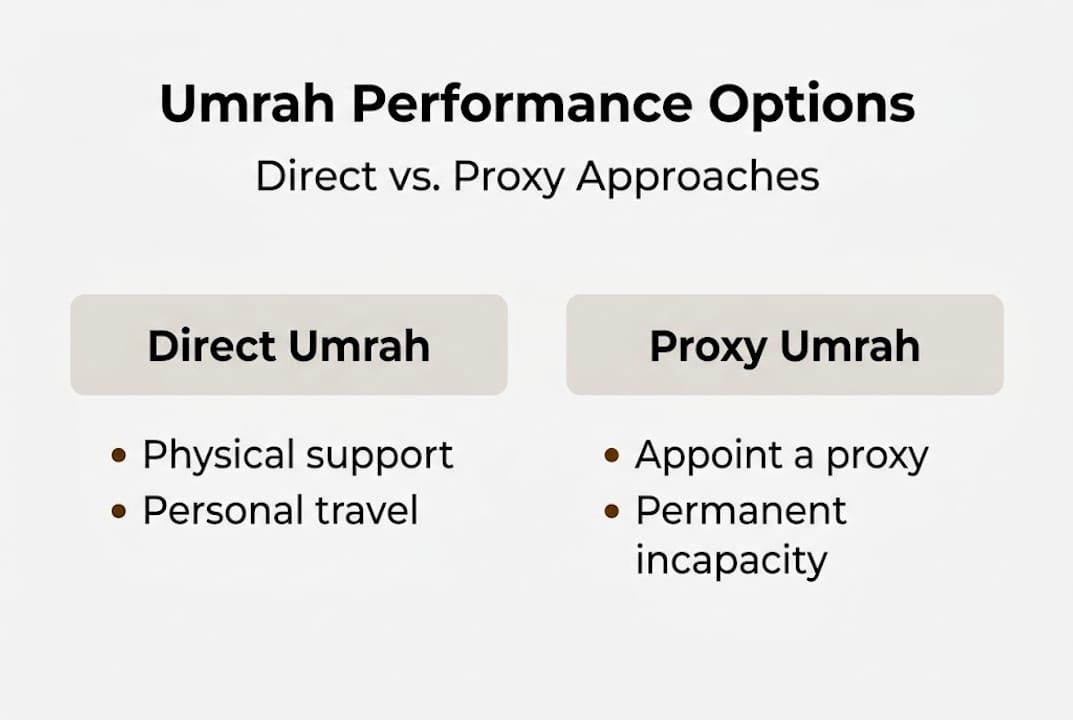
For a thorough review of the legal basis, the Umrah proxy rulings page explains the scholarly consensus in plain terms.
Pro Tip: Avoid appointing a proxy casually. If the beneficiary’s condition is temporary or uncertain, scholars advise waiting. Performing Badal Umrah prematurely, before it is truly necessary, may not fulfill the obligation and could create spiritual confusion about whether the duty has been met.
Jurisprudence and scholarly views: Is accessibility through a proxy always valid?
The permissibility of proxy Umrah is not a modern invention. It is grounded in authentic Hadith and recognized across most major Islamic legal schools, though with some important differences.
The Hadith foundation
The most frequently cited evidence comes from Sahih Bukhari 1513, in which a woman asks the Prophet Muhammad (peace be upon him) whether she may perform Hajj on behalf of her incapacitated father. The Prophet affirmed this, and scholars have extended the ruling to Umrah by analogy.
“The Prophet’s response established a principle of compassionate substitution, one that honors both the incapacitated person’s sincere desire and the community’s responsibility to support them.”
How the four major schools differ
| School | Proxy for living (incapacitated) | Proxy for deceased |
|---|---|---|
| Hanafi | Permissible | Permissible |
| Shafi’i | Permissible | Permissible |
| Hanbali | Permissible | Permissible |
| Maliki | Not permitted | Permissible |
The Maliki school stands apart by restricting proxy Umrah to the deceased. For families following the Maliki tradition, this is an important distinction. For those following Hanafi, Shafi’i, or Hanbali rulings, proxy Umrah for a living incapacitated person is valid.
For guidance on performing Umrah on behalf of someone who has passed away, the Umrah for deceased guide addresses the specific rules that apply.
What if the beneficiary recovers?
This is a genuine edge case that scholars debate. According to scholarly edge cases discussed by Islamic jurists, if a person recovers after proxy Umrah has been performed on their behalf, the majority view is that the proxy Umrah still counts. However, some scholars recommend that the recovered person perform Umrah themselves as an additional act of worship, out of caution. Families should consult a qualified scholar if this situation arises.
For broader context on how family Umrah practices work across different circumstances, that resource covers a range of scenarios.
Modern accessibility: How Saudi Arabia supports Umrah for all
The legal permission for proxy Umrah exists because direct performance is not always possible. But Saudi Arabia’s ongoing investments in accessibility mean that more pilgrims than ever before can perform Umrah themselves, even with significant physical limitations.

What is currently available
The Saudi accessibility initiatives include a wide range of services:
- Dedicated wheelchair lanes throughout Masjid al-Haram
- Motorized scooters available for rent near the Haram
- Trained staff to assist pilgrims with mobility challenges during Tawaf and Sa’i
- Accessible restrooms and prayer areas
- Medical teams stationed throughout the pilgrimage route
- Accessible accommodation options near the Haram for those with specific needs
Over 524 disabled pilgrims completed Hajj rituals with direct support during the 2025 initiative. This is not a small number. It represents families who chose direct performance over proxy because the infrastructure made it possible.
Direct performance vs. proxy: How to choose
The general principle is straightforward. If direct performance is medically feasible with support, it is preferable. Proxy Umrah is a last resort, not a first option. Families should honestly assess the beneficiary’s condition with a doctor and, ideally, with a knowledgeable Islamic scholar before deciding.
For those interested in how Islamic pilgrimage understanding informs these decisions, that resource provides helpful context.
Pro Tip: If you are planning direct Umrah for an elderly or disabled family member, contact the Saudi Ministry of Hajj and Umrah’s accessibility services well before your travel date. Arrangements for electric carts and dedicated assistance often need to be made in advance, and early planning significantly reduces stress on arrival.
For those whose loved ones benefit from Umrah humanitarian support programs, these services often connect pilgrims with additional resources.
A balanced approach: Our perspective on accessibility and spiritual intent
Here is something that often gets overlooked: proxy Umrah is a mercy, not a convenience. We have seen families rush to arrange Badal Umrah for a parent who, with proper planning and the right support, could have made the journey themselves. That is a missed opportunity, not just logistically but spiritually.
Direct participation in Umrah carries a depth of personal experience that no proxy can replicate for the worshipper. The physical act of standing at the Kaaba, of walking the path of Hajar, matters. Saudi Arabia’s accessibility investments exist precisely to protect that experience for as many people as possible.
At the same time, when direct performance is genuinely impossible, proxy Umrah performed with correct niyyah and full compliance is a beautiful act of communal care. The risk lies in misuse: appointing a proxy without exhausting direct options, or doing so without sincere intention. Correct niyyah, naming the beneficiary explicitly, is what transforms a physical act into a valid religious fulfillment.
Families should treat the decision seriously. Consult a scholar. Explore proxy faith fulfillment resources. And remember that the intention behind the act matters as much as the act itself.
How Badal Umrah services can help you fulfill religious obligations
When proxy Umrah is the right choice, choosing a trustworthy provider is essential. Badal Umrah offers Sharia-compliant proxy services with full transparency, including video and photo documentation of the rites, personalized certificates, and clear communication throughout the process.
Every package is performed by verified, qualified proxies who have completed their own Umrah and understand the religious requirements. The Barakah Premium proxy package includes comprehensive documentation for families who want complete peace of mind. For those seeking a focused option, the Du’a proxy package offers sincere supplication on behalf of your loved one. Browse the full Umrah package collection to find the option that best fits your family’s needs and intentions.
Frequently asked questions
Can Umrah be performed on behalf of someone who is temporarily ill?
No. Proxy Umrah is only valid for those with permanent incapacity and no realistic hope of recovery. Temporary illness, busyness, or financial difficulty alone do not qualify.
What accessibility services are available for elderly or disabled pilgrims in Saudi Arabia?
Free wheelchairs, electric carts, ramps, sign language services, and Braille materials are available at airports and throughout the holy sites in Makkah and Madinah.
Is proxy Umrah accepted by all Islamic scholars?
Most major schools, including Hanafi, Shafi’i, and Hanbali, permit proxy Umrah for the permanently incapacitated. The Maliki school permits proxy only for the deceased, not for living persons.
Does Saudi Arabia regulate or prohibit proxy Umrah?
No official ban or regulation exists. Saudi policy currently focuses on physical accessibility improvements rather than restricting or governing proxy arrangements.
What is the most important intention for a proxy performing Umrah?
The proxy must make an explicit niyyah naming the beneficiary before entering Ihram. Without this clear intention, the rites may not count on behalf of the intended person.