

What is Badal Umrah? Complete 2026 guide for families
Many Muslim families believe they must personally travel to Mecca to fulfill the sacred pilgrimage of Umrah, even when elderly parents or chronically ill relatives cannot physically make the journey. This creates spiritual distress and feelings of incomplete religious duty. However, Islamic jurisprudence provides a compassionate solution through Badal Umrah, allowing a qualified person to perform this sacred ritual on behalf of someone unable to do so themselves. This comprehensive guide explains what Badal Umrah entails, who qualifies, how it differs from traditional Umrah, and how to choose legitimate services that honor both religious requirements and your family’s trust.
Table of Contents
- Understanding What Badal Umrah Means In Islam
- Who Can Request And Perform Badal Umrah?
- How Badal Umrah Differs From Normal Umrah: A Comparison
- Choosing And Verifying A Legitimate Badal Umrah Service
- Explore Trusted Badal Umrah Packages And Services
- Frequently Asked Questions About Badal Umrah
Key takeaways
| Point | Details |
|---|---|
| Definition and purpose | Badal Umrah allows a qualified Muslim to perform the pilgrimage on behalf of someone physically unable to travel due to illness, old age, or death |
| Eligibility requirements | Only immediate family members or legal heirs can typically request it, and the performer must be a practicing Muslim who has completed their own obligatory Umrah |
| Documentation matters | Legitimate services provide certificates, photos, videos, and transparent communication to verify the pilgrimage was performed correctly |
| Religious validity | When done according to Islamic guidelines with proper intention and authorization, Badal Umrah fulfills the religious obligation and brings spiritual reward |
| Service verification | Choose providers with clear credentials, client testimonials, detailed proof of performance, and transparent processes to avoid exploitation |
Understanding what Badal Umrah means in Islam
The term “Badal” in Arabic translates to “on behalf of” or “substitute,” making Badal Umrah the performance of the sacred pilgrimage for another person who cannot undertake it themselves. This practice has deep roots in Islamic jurisprudence, supported by Hadith narrations where companions of the Prophet Muhammad sought permission to perform Hajj or Umrah for relatives unable to travel. The concept addresses a fundamental question: what happens when someone has the sincere desire and financial means to perform Umrah but lacks physical ability?
Islamic scholars across different schools of thought recognize Badal Umrah as religiously valid under specific conditions. The person being represented must genuinely be unable to perform the pilgrimage due to chronic illness, advanced age, permanent disability, or death. Temporary obstacles like short term illness or financial constraints do not typically qualify, as the individual should wait until conditions improve. The religious basis stems from the principle that Allah does not burden a soul beyond its capacity, and Islamic law provides mechanisms for those facing genuine hardship.
Several categories of people qualify for having Badal Umrah performed on their behalf:
- Elderly individuals who cannot physically endure the journey or ritual requirements
- Chronically ill patients with permanent conditions preventing travel
- Deceased Muslims who expressed the wish to perform Umrah but passed away before doing so
- Permanently disabled individuals unable to complete the physical aspects of the pilgrimage
A common misconception suggests that anyone can casually perform Umrah for others as a shortcut or business transaction. This misunderstands the sacred nature of the act. The performer must have sincere intention, make the proper declaration of intent at the designated boundary points, and fulfill all ritual requirements with the same devotion as a personal pilgrimage. The spiritual reward benefits both the person represented and the performer, but only when conducted with genuine religious commitment rather than mere financial exchange.
Pro Tip: Before arranging Badal Umrah, consult with a knowledgeable Islamic scholar familiar with your specific madhab to ensure all conditions are properly met for your family’s situation.
Who can request and perform Badal Umrah?
Not everyone can simply decide to have Umrah performed on their behalf, nor can just anyone serve as the performer. Islamic guidelines establish clear eligibility criteria to maintain the spiritual integrity of this sacred practice. Understanding these requirements protects families from invalid arrangements and ensures the religious obligation is genuinely fulfilled.
For those requesting Badal Umrah, immediate family members typically hold the authority to arrange it. This includes children for parents, spouses for each other, or siblings in certain circumstances. When the person is deceased, legal heirs according to Islamic inheritance law usually make the decision. The requester should have knowledge of the person’s genuine inability to perform Umrah themselves and ideally have their permission if they are living. Deceased individuals who left a will expressing the desire for Umrah or Hajj create a clear mandate for family members to fulfill.
The person performing Badal Umrah carries significant religious responsibility and must meet several conditions:
- Must be a practicing Muslim who understands and can properly execute all Umrah rituals
- Should have already completed their own obligatory Umrah if they were previously obligated
- Must be physically and mentally capable of undertaking the journey and completing the rites
- Should have sincere intention and make the proper declaration when entering ihram
- Must be trustworthy and committed to fulfilling the task with complete religious devotion
Charitable organizations and specialized services have emerged to coordinate Badal Umrah for families who do not have suitable relatives available to perform it. These organizations typically employ or contract with qualified individuals who regularly perform the pilgrimage on behalf of others. The best services maintain rigorous standards for their performers, verify their religious knowledge, and provide comprehensive documentation of each pilgrimage completed.
Ethical considerations become crucial when money exchanges hands for Badal Umrah services. While compensating someone for their time, travel, and expenses is permissible, the arrangement should never feel like a purely commercial transaction. The performer must maintain sincere religious intention rather than viewing it merely as paid work. Families should be wary of services that seem to commodify the sacred ritual or make exaggerated promises about spiritual rewards. Transparency, religious knowledge, and genuine commitment to proper performance matter far more than the lowest price.
Pro Tip: When selecting someone to perform Badal Umrah, prioritize their religious commitment and knowledge of rituals over convenience or cost, as the spiritual validity depends entirely on proper execution with sincere intention.
How Badal Umrah differs from normal Umrah: A comparison
While Badal Umrah and personal Umrah share the same physical rituals and sacred locations, several key distinctions separate the two practices in terms of intention, authorization, documentation, and spiritual implications. Understanding these differences helps families appreciate what makes Badal Umrah a unique form of worship rather than simply a delegated task.

The most fundamental difference lies in the declaration of intention. When performing personal Umrah, a pilgrim enters the state of ihram with the intention for themselves alone. For Badal Umrah, the performer must explicitly state they are undertaking the pilgrimage on behalf of the named individual, making this declaration at the miqat boundary before entering the sacred precinct. This verbal and intentional specification transforms the entire act into a representation rather than a personal worship.
| Aspect | Normal Umrah | Badal Umrah |
|---|---|---|
| Intention declaration | “I intend Umrah for myself” | “I intend Umrah on behalf of [named person]” |
| Authorization needed | None, personal decision | Requires family permission or legal heir approval |
| Documentation | Optional, personal records only | Certificates, photos, videos typically required |
| Spiritual reward | Accrues entirely to the performer | Primary reward to represented person, secondary to performer |
| Eligibility to perform | Any Muslim meeting basic conditions | Must have completed own obligatory Umrah first |
| Frequency | Can be repeated unlimited times | Each performance must be for a different qualifying person |
The procedural steps for Badal Umrah follow this sequence:
- Verify the person being represented genuinely qualifies under Islamic guidelines
- Obtain proper authorization from the individual or their legal heirs
- Select a qualified performer who meets all religious requirements
- Ensure the performer clearly understands whose behalf they are acting on
- Have the performer make the explicit intention declaration at the miqat
- Complete all standard Umrah rituals with the same devotion as personal pilgrimage
- Obtain documentation proving the pilgrimage was performed, including certificates and visual evidence
- Deliver the documentation to the family as confirmation of fulfillment
Documentation plays a far more significant role in Badal Umrah than in personal pilgrimage. Since the family is not present to witness the performance, legitimate services provide certificates with details of who performed the Umrah, on whose behalf, the dates, and often include photos or videos at key locations like the Kaaba, Safa and Marwa, and during tawaf. This evidence serves both practical verification and spiritual reassurance for families.
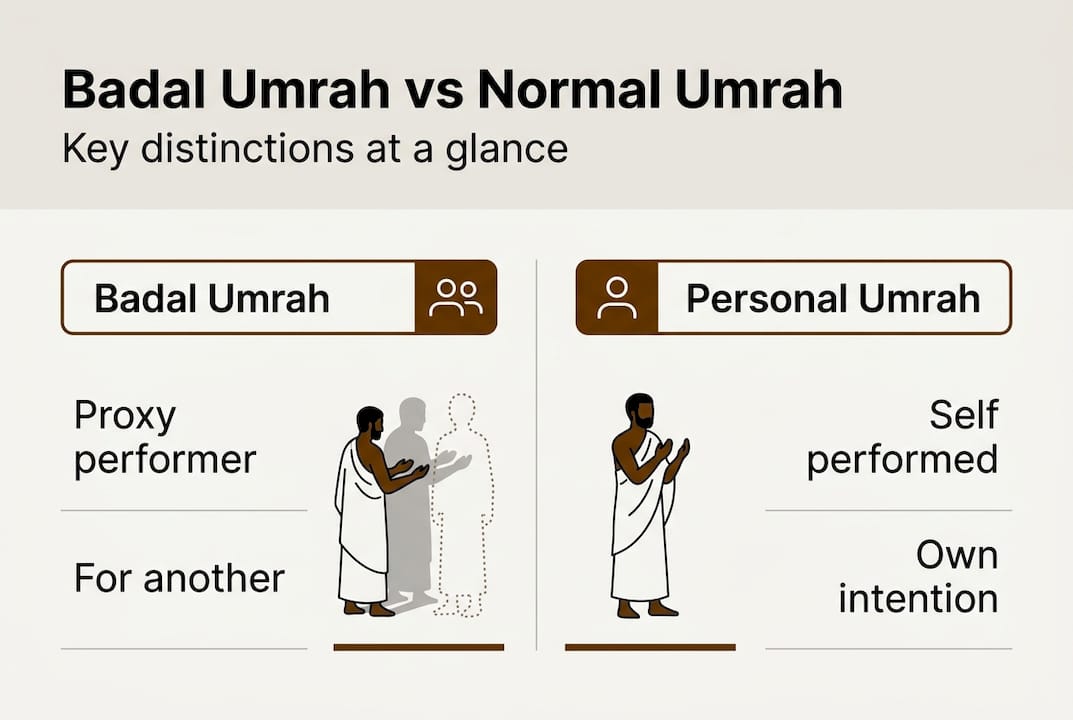
The spiritual implications deserve careful consideration. Islamic scholars agree that when performed correctly with proper intention, the primary spiritual reward and fulfillment of obligation transfer to the person being represented. The performer also receives reward for their sincere effort and devotion, creating a beautiful exchange of blessing. However, this transfer only occurs when all conditions are met. An improperly performed Badal Umrah with incorrect intention or missing requirements may not fulfill the religious obligation, leaving the represented person’s duty incomplete.
Choosing and verifying a legitimate Badal Umrah service
With the growth of online services offering Badal Umrah, families face the critical challenge of distinguishing trustworthy providers from those who may exploit religious sentiment for profit. Verification requires examining multiple factors including credentials, transparency, documentation practices, and community reputation. Your choice directly impacts whether the religious obligation is genuinely fulfilled.
Start by investigating the provider’s credentials and organizational background. Legitimate services typically have clear information about their founding, mission, religious oversight, and years of operation. Look for services that openly share their process, explain their religious compliance measures, and demonstrate knowledge of Islamic jurisprudence regarding Badal Umrah. Organizations with scholarly endorsements or affiliations with recognized Islamic institutions carry more credibility than anonymous websites with minimal information.
Key factors to verify before selecting a service include:
- Transparent explanation of how performers are selected, trained, and verified
- Clear documentation of what evidence you will receive after performance
- Accessible customer service with real people who can answer detailed questions
- Published testimonials from previous clients with verifiable details
- Explicit statement of religious guidelines followed and scholarly references
- Reasonable pricing that reflects actual costs rather than suspiciously low rates
- Clear refund or guarantee policies if performance cannot be completed
Red flags that should prompt extreme caution or outright avoidance:
- Vague descriptions of services without specific details about documentation
- No clear contact information or physical address for the organization
- Promises that sound too good to be true or exaggerated spiritual claims
- Inability to provide references or previous client testimonials
- Pressure tactics urging immediate payment without time for research
- Lack of clarity about who will perform the Umrah and their qualifications
- No explanation of how you will verify the pilgrimage was actually performed
The documentation provided after performance serves as your primary verification. Reputable services issue detailed certificates including the performer’s name, the represented person’s name, specific dates of performance, and often a breakdown of when each ritual was completed. Photos should show the performer at recognizable locations within the Haram, ideally with some form of identification linking them to your specific request. Video documentation offers even stronger evidence, particularly if it shows the performer making the intention declaration or completing tawaf.
Pro Tip: Before making final payment, request to speak directly with a previous client who used the service, and ask the provider for examples of the exact documentation you will receive, ensuring it meets your expectations for verification and spiritual reassurance.
Cross reference any service you are considering with community feedback. Check Islamic forums, ask at your local mosque, and consult with family or friends who have previously arranged Badal Umrah. Personal recommendations from trusted community members carry significant weight. Be especially careful with services that have no presence in Muslim community discussions or that cannot provide any independent verification of their legitimacy.
Explore trusted Badal Umrah packages and services
After understanding what Badal Umrah entails and how to verify legitimate providers, you are ready to explore specific service packages designed to meet different family needs and budgets. Trusted providers offer structured options that include comprehensive documentation, visual proof of performance, and certificates to provide spiritual reassurance and religious validity.
Consider packages that align with your family’s priorities for documentation and communication. The Umrah Badal Du’a Package offers essential services with standard certification, while the Umrah Badal Barakah Premium Package provides enhanced documentation including detailed photo and video coverage for families seeking more comprehensive evidence. For those wanting a balanced option, the Umrah Badal Noor Package combines core verification with meaningful visual documentation.
Each package should clearly outline what you receive, the timeline for performance, how you will be updated during the process, and what final documentation arrives after completion. Selecting a service that matches your comfort level with verification and your family’s specific situation ensures peace of mind that this sacred obligation is fulfilled with proper religious devotion and complete transparency.
Frequently asked questions about Badal Umrah
Who is eligible to have Badal Umrah performed on their behalf?
Eligibility requires genuine inability to perform Umrah personally due to permanent conditions like chronic illness, advanced age, severe disability, or death. Temporary obstacles such as short term sickness or current financial constraints do not qualify, as the person should wait until they can perform it themselves. The individual must also have the sincere desire and, if living, should ideally grant permission for someone to perform it on their behalf.
Can Badal Umrah be performed for deceased relatives?
Yes, performing Badal Umrah for deceased Muslims is explicitly permitted and widely practiced, particularly when the deceased expressed a wish to perform Umrah but passed away before doing so. Legal heirs according to Islamic inheritance law typically have the authority to arrange and authorize this on behalf of the deceased. Islamic rulings confirm that the spiritual reward and fulfillment transfer to the deceased when performed with proper intention and procedures.
Does Badal Umrah carry the same spiritual reward as performing it personally?
The spiritual reward structure differs between personal and proxy performance. When Badal Umrah is performed correctly with sincere intention, the primary reward and fulfillment of the religious obligation transfer to the person being represented. The performer also receives reward for their devotion and effort, but the main benefit goes to the individual who could not undertake the journey themselves, fulfilling their religious duty.
How can a family arrange Badal Umrah if no relatives are available to perform it?
Families can engage legitimate charitable organizations or specialized services that coordinate Badal Umrah through qualified performers. Following a step by step process ensures proper arrangement: research and verify the service provider, select an appropriate package, provide necessary information about the person being represented, arrange payment, receive confirmation of performance dates, and obtain final documentation including certificates and visual proof.
What are common misconceptions about Badal Umrah permissions and validity?
Many people incorrectly believe anyone can perform Umrah for anyone else without specific conditions, or that it is merely a commercial transaction. In reality, strict religious requirements govern who qualifies for representation, who can perform it, and how intention must be declared. Another misconception suggests Badal Umrah is somehow less valid than personal performance, when Islamic jurisprudence clearly establishes it as a legitimate fulfillment of religious obligation for those genuinely unable to travel.
How do I verify that the Badal Umrah was actually performed correctly?
Verification relies on comprehensive documentation from trustworthy providers. Legitimate services provide detailed certificates with performer and represented person names, specific dates, and ritual completion confirmations. Photos showing the performer at recognizable Haram locations and videos documenting key moments like the intention declaration and tawaf offer strong evidence. Cross reference the service with community testimonials and ensure they provide this documentation as standard practice rather than upon special request.