

Understanding proxy worship in Islam: fulfill Umrah with dignity
TL;DR:
- Proxy worship (badal) allows capable Muslims to perform Umrah for those unable due to health or age.
- Conditions for validity include genuine incapacity, proper intention, and complete rites performed correctly.
- Trusted services can facilitate lawful proxy Umrah, ensuring accountability, proper procedures, and spiritual rewards.
Many Muslims and their families carry a quiet worry: if a loved one cannot physically travel to Makkah, does their religious obligation go unfulfilled? This concern is understandable, but Islamic scholarship offers a clear and compassionate answer. Proxy worship, known in Arabic as badal, allows a capable Muslim to perform Umrah on behalf of someone who cannot. This guide explains what proxy worship means in Islam, when it is valid, how to arrange it properly, and why it reflects the mercy at the heart of Islamic law. Whether you are a family member or someone facing health or age limitations, this article offers the clarity you need.
Table of Contents
- What is proxy worship (badal) in Islam?
- Conditions and legitimacy of proxy Umrah
- How to arrange proxy worship: Process, ethics, and practical steps
- Spiritual impact and considerations for families
- Why proxy worship embodies Islamic compassion
- How to get started with trusted proxy Umrah services
- Frequently asked questions
Key Takeaways
| Point | Details |
|---|---|
| Proxy worship defined | Proxy worship (badal) allows another person to complete religious duties like Umrah for someone who cannot due to valid reasons. |
| Legal and spiritual foundation | Islamic law and scholarship provide clear conditions and spiritual rewards for proxy worship when performed sincerely. |
| Practical steps matter | Arranging proxy Umrah requires careful selection, transparent processes, and verification of chosen proxies or organizations. |
| Families stay involved | Loved ones can participate spiritually through du’a, intention, and maintaining connection throughout the process. |
| Compassionate fulfillment | Proxy worship reflects Islamic compassion, ensuring everyone can seek their religious obligations with dignity. |
What is proxy worship (badal) in Islam?
To build a clear foundation, let’s explain exactly what proxy worship means in Islamic tradition.
Proxy worship, or badal, refers to the practice of one Muslim performing a religious act on behalf of another who is unable to do so themselves. In the context of Umrah, this means a physically capable Muslim travels to Makkah, enters the state of Ihram (the sacred state of ritual purity), performs Tawaf (the circumambulation of the Kaaba), completes Sa’i (the walk between Safa and Marwa), and performs Tahallul (the ritual cutting of hair to exit Ihram), all while holding the intention that these acts are being performed for the person who cannot be present.
This is not a modern invention or a workaround. Proxy worship is rooted in Islamic tradition and has scholarly endorsement under certain conditions. Classical Islamic jurists from all four major schools of thought have discussed and, in many cases, affirmed the validity of badal Umrah under specific circumstances.
So who can take part, and why does it matter? The practice is primarily designed for:
- Muslims who are elderly and physically unable to travel
- Those with permanent or serious illness that prevents travel
- Individuals who passed away before fulfilling their Umrah obligation
- People with severe disabilities that make the pilgrimage impossible
The underlying principle is one of mercy. Islamic law recognizes that not every believer has the same physical capacity, and it does not penalize those who face genuine barriers. The practice of performing Umrah for others is grounded in this spirit of accommodation.
Intention, known as niyyah, is central to the validity of proxy worship. The proxy must clearly intend at the start of the ritual that they are performing Umrah on behalf of the named individual. This intention is what directs the spiritual benefit toward the person being represented.
“Verily, actions are by intentions, and every person will have only what they intended.” This hadith, recorded in Sahih Bukhari and Muslim, is the foundation upon which the legitimacy of proxy worship rests.
Understanding the Islamic rulings for proxy Umrah helps families feel confident that they are honoring their loved ones in a way that is spiritually sound and religiously recognized.
Conditions and legitimacy of proxy Umrah
Understanding the core concept, let’s look at how proxy worship is recognized as legitimate in practice.
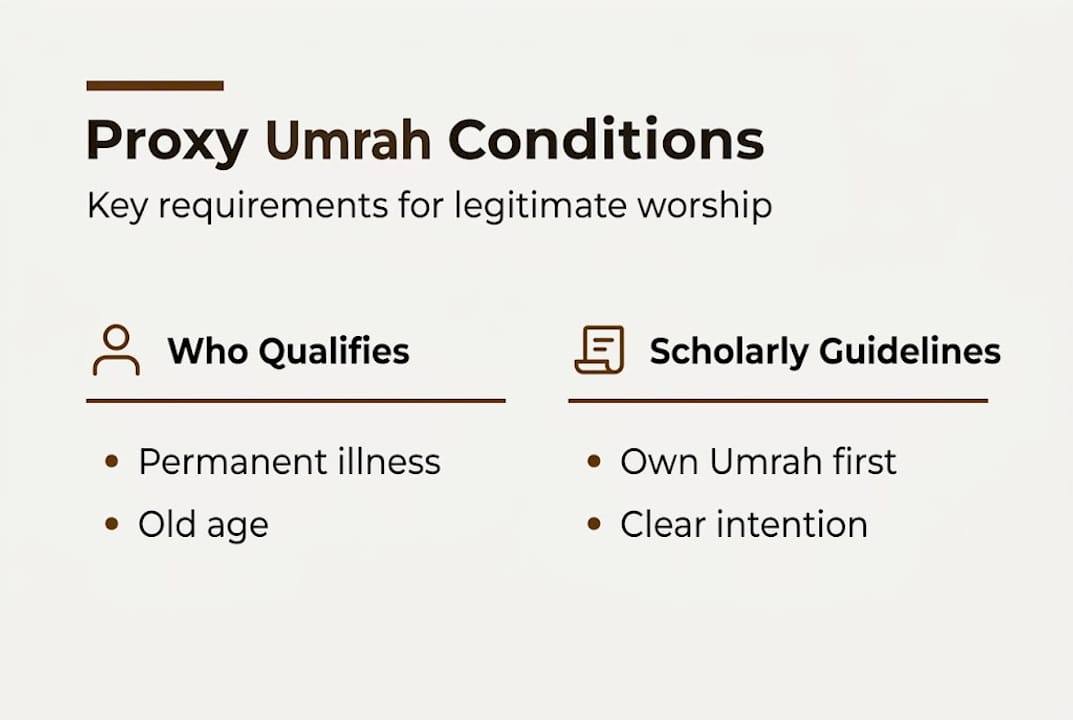
Islam allows proxy Umrah for those unable due to permanent illness or old age, guided by clear religious rulings. However, not every situation qualifies. There are defined conditions that must be met for the proxy Umrah to be considered valid.
| Condition | Details |
|---|---|
| Incapacity of the original person | Must be permanent or long-term, not temporary |
| Proxy’s own Umrah | The proxy should ideally have already performed their own Umrah |
| Clear intention (niyyah) | Proxy must intend the act for the named person from the start |
| Proper completion | All rites must be completed correctly, including Tawaf, Sa’i, and Tahallul |
| No compensation without agreement | Financial arrangements must be transparent and agreed upon |
The type of incapacity matters. Scholars distinguish between temporary illness, which does not qualify, and permanent or chronic conditions that make travel realistically impossible. Old age that severely limits mobility is widely accepted as a valid reason. Mental incapacity is also recognized in many scholarly opinions.
Documentation is increasingly important, especially when using a service or nonprofit. Families should request confirmation of the proxy’s identity, their completed rites, and any photographic or video evidence of the pilgrimage. This is not about distrust. It is about ensuring accountability and peace of mind.
Common pitfalls to avoid include appointing a proxy who has not yet performed their own Umrah, failing to specify the intended person clearly, or working with unverified individuals who cannot confirm they completed all rites properly. Checking the rulings on Badal Umrah before proceeding is a wise step.
Is Umrah for others truly permissible? Yes, when the conditions are met. The key is informed, careful preparation.
Pro Tip: Always verify the credentials of the proxy or the service you choose. Ask for documentation of completed rites, including the proxy’s own Umrah history, and request confirmation of the specific intention made on behalf of your loved one.
How to arrange proxy worship: Process, ethics, and practical steps
Once a proxy arrangement is deemed legitimate, here’s how families can go about arranging Umrah Badal properly.
Arranging proxy Umrah involves both practical planning and ethical responsibility. Here is a clear step-by-step process:
- Confirm eligibility. Verify that the person on whose behalf Umrah is being arranged genuinely meets the conditions of permanent incapacity or has passed away.
- Choose your proxy option. Decide whether a trusted family member or a specialized service will perform the Umrah.
- Set a clear intention. The proxy must state the name of the person they are performing Umrah for at the time of entering Ihram.
- Complete all rites correctly. Tawaf, Sa’i, and Tahallul must all be performed in full, following proper Islamic procedure.
- Request documentation. Ask for written confirmation, photos, or video evidence of the completed Umrah.
- Make du’a. Encourage the proxy to make sincere supplications for the person on whose behalf they are performing the rites.
Nonprofits and specialized services can facilitate legitimate proxy Umrah on your behalf, offering structured processes and accountability that individual arrangements may lack.
| Option | Family proxy | Nonprofit or service |
|---|---|---|
| Accountability | Depends on trust | Structured documentation |
| Verification | Informal | Formal confirmation provided |
| Experience | Variable | Trained and experienced |
| Cost | Often lower | Transparent fee structure |
| Accessibility | Limited by availability | Available to all globally |
For families whose members cannot travel to Makkah themselves, humanitarian proxy Umrah services offer a reliable path. For elderly pilgrims who may need support even if they travel themselves, Umrah transport for elderly options are also available in Saudi Arabia.
Ethics matter throughout this process. The proxy must act with sincerity, not treat the task as routine, and approach it with the same reverence they would bring to their own worship. Understanding spiritual legitimacy in proxy Umrah helps both families and proxies approach the arrangement with the right mindset.

Spiritual impact and considerations for families
Beyond legalities and logistics, families often seek comfort and meaning in this process.
For many families, arranging proxy Umrah is an act of deep love. It is a way of saying: even though you cannot be there, your faith matters, and we will carry it forward on your behalf. This emotional and spiritual dimension deserves as much attention as the practical steps.
One of the most common questions families ask is whether the reward of the Umrah actually reaches their loved one. Islamic scholars offer reassurance here. The reward of a proxy Umrah is hoped to reach both the one performing it and the one it is performed on behalf of, by the mercy of Allah. This is not a guarantee in the mechanical sense, but a hope grounded in the generosity of Allah’s mercy and the sincerity of the intention.
Families can stay spiritually connected to the process in several meaningful ways:
- Make du’a together. Gather as a family to pray for the person on whose behalf Umrah is being performed, especially during the time the proxy is in Makkah.
- Fast on the day of the Umrah. Some families choose to fast on the day the proxy performs the rites as a sign of solidarity and spiritual participation.
- Send a personal du’a list. Share specific supplications with the proxy so they can make them at the Kaaba and during Sa’i.
- Maintain sincerity. Remind yourselves and the proxy that the value of this act lies in its intention, not its appearance.
- Avoid doubt. Trust in Allah’s mercy and the legitimacy of the process when all conditions are properly met.
Understanding proxy and direct Umrah accessibility helps families see that Islam has always sought to include, not exclude, those who face physical barriers to worship.
Pro Tip: Ask your proxy to make a specific du’a at the Multazam, the area between the Black Stone and the door of the Kaaba, as this is considered a place where supplications are especially accepted. Provide them with the name and a personal message to carry into their prayer.
Why proxy worship embodies Islamic compassion
Having navigated facts and steps, let’s reflect on the heart of the matter: compassion and dignity.
There is a misconception that Islam demands individual performance of every act of worship without exception. This view, while well-intentioned, overlooks the profound mercy built into Islamic jurisprudence. Proxy worship is not a loophole. It is a deliberate provision, one that reflects how deeply Islamic law values inclusion.
When an elderly parent can no longer walk the paths of Makkah, or when illness confines someone to a bed, the option of proxy Umrah restores their dignity. It says: your faith is not diminished by your body’s limitations. The special provisions for ill persons within Umrah rites are not afterthoughts. They are evidence of a legal tradition that centers human mercy.
We believe that families who arrange proxy Umrah are not taking a shortcut. They are honoring a loved one’s lifelong faith with sincerity and care. That act, done with the right intention, carries its own spiritual weight. It is one of the most loving things a family can do.
How to get started with trusted proxy Umrah services
If you or a loved one is considering proxy Umrah, here’s how to begin with confidence.
Choosing a trustworthy service is the most important step you can take. Families deserve transparency, documentation, and genuine religious care, not just a transaction.
At Badal Umrah, we specialize in performing Umrah on behalf of those who cannot, with full documentation, video coverage, and personalized certificates. Our Umrah Badal service is designed to give families peace of mind and spiritual assurance. We follow proper Islamic procedures at every step, and 10% of every booking supports humanitarian efforts in Gaza. To learn more about proxy Umrah and explore our packages, visit our website and take the first step toward fulfilling this sacred obligation with dignity.
Frequently asked questions
Who can appoint someone for proxy Umrah in Islam?
A Muslim who is permanently unable to perform Umrah due to illness or old age can appoint a proxy according to Islamic law. The incapacity must be genuine and long-term, not a temporary condition.
Is the reward of Umrah received by both the proxy and the original intending person?
Yes, many scholars state that both the proxy and the one intended share in the spiritual reward, by the will of Allah. The reward is hoped to reach both through Allah’s mercy and the sincerity of the intention.
How do I ensure my proxy worship is valid?
Confirm the proxy meets eligibility and follows proper Islamic procedures, including a clear intention and completion of all rites. Reviewing the set criteria for proxy Umrah before arranging anything is strongly recommended.
Can nonprofits or agencies facilitate proxy Umrah?
Yes, many reputable organizations arrange proxy Umrah according to Islamic guidelines. Nonprofits can act as intermediaries for legitimate proxy Umrah, often providing structured documentation and accountability that individual arrangements may not offer.
Recommended
- How to ensure spiritual legitimacy in proxy Umrah – Badal Umrah
- Community service in Umrah: How proxy faith fulfillment works – Badal Umrah
- Islamic rulings for performing Umrah on behalf of others – Badal Umrah
- Umrah accessibility guide: proxy and direct performance – Badal Umrah
- Why premium services matter for your first Umrah pilgrimage