

Istighfar: 70x daily forgiveness and spiritual growth
TL;DR:
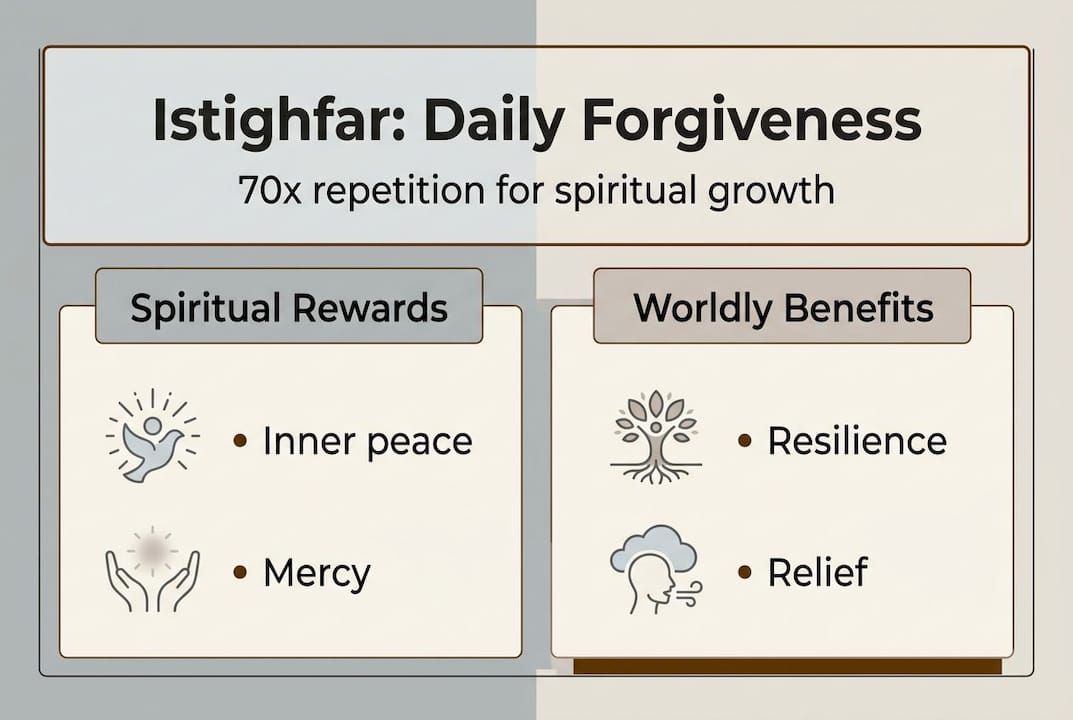
- Istighfar is seeking Allah’s forgiveness with sincerity and humility, not just words.
- The Qur’an links istighfar to both spiritual mercy and worldly blessings like rain and provision.
- Even if unable to perform Umrah, sincere istighfar remains a powerful, accessible path to Allah’s mercy.
Many Muslims carry a quiet belief that deep, lasting forgiveness is only truly unlocked after performing Umrah or Hajj. This is understandable. Pilgrimage is a powerful act of worship, rich with spiritual meaning. But Islam places another door to Allah’s mercy right in front of you, every single day. That door is istighfar, seeking Allah’s forgiveness through sincere words and a humble heart. This guide explains what istighfar means, how it differs from repentance, what the Qur’an says about its rewards, how to practice it daily, and how it relates to the pilgrimage for those who cannot travel.
Table of Contents
- What is istighfar in Islam?
- Qur’anic perspective: Spiritual rewards and worldly benefits
- Istighfar in daily practice: Sunnah, routines, and sincerity
- Istighfar versus Umrah: Pathways to forgiveness explained
- A fresh perspective: Why istighfar is the heart of returning to Allah
- Connect your journey: Next steps in seeking forgiveness
- Frequently asked questions
Key Takeaways
| Point | Details |
|---|---|
| Istighfar is accessible | Anyone can seek Allah’s forgiveness through sincere istighfar, regardless of location or ability to perform Umrah. |
| Heart and words matter | Sincerity, regret, and intention are key—simply reciting words without meaning is not enough. |
| Practical benefits | The Qur’an links istighfar to spiritual and worldly benefits, such as blessings and relief. |
| No substitute needed | Even without Umrah, Allah’s mercy is open to all who seek forgiveness and make things right with others. |
What is istighfar in Islam?
With the misconception clarified, let’s precisely define what istighfar means in both the linguistic and spiritual sense.
The word istighfar comes from the Arabic root gh-f-r, which means to cover or shield. Linguistically, it refers to asking Allah to cover and protect you from the consequences of your sins. In practice, istighfar means asking Allah for forgiveness, most commonly expressed through the phrase Astaghfirullāh, which translates as “I seek forgiveness from Allah.” This phrase is short, but its weight is significant.
Many people use istighfar and tawbah (repentance) interchangeably, but scholars draw a clear distinction. Understanding the difference between tawbah and istighfar matters because it shapes how sincerely you approach each act.
| Term | Meaning | Key requirement |
|---|---|---|
| Istighfar | Seeking verbal forgiveness from Allah | Sincerity of tongue and heart |
| Tawbah | Full repentance | Regret, stopping the sin, resolving not to return |
Think of istighfar as the door you knock on, and tawbah as the full process of walking through it. You can say Astaghfirullāh at any moment, but tawbah requires:
- Genuine remorse for the sin committed
- Stopping the sinful act immediately
- A firm intention never to repeat it
- Returning any wrongfully taken rights (when applicable)
Scholars emphasize that istighfar said without awareness or feeling is less effective. Saying the words while your heart is distracted or indifferent weakens the act. As the famous scholar Ibn al-Qayyim observed:
“Istighfar that is on the tongue only, without the heart’s participation, is not the istighfar that opens the doors of mercy.”
This is why sincerity sits at the center of the practice. The words matter, but the condition of your heart matters more. Understanding these fundamentals also helps when exploring broader Islamic rituals explained in context with the five pillars and Umrah.
Qur’anic perspective: Spiritual rewards and worldly benefits
After understanding the core concept of istighfar, discover how the Qur’an elevates its importance with direct benefits for your spiritual and worldly life.
The Qur’an does not treat istighfar as a minor side practice. It connects it directly to forgiveness, mercy, and even tangible blessings in this world. Surah Hūd 11:3 and Surah Nūḥ 71:10-12 both illustrate this link, showing that sincere seeking of forgiveness invites Allah’s provision, rain, wealth, and children.
Prophet Nuh (Noah) told his people:
“Ask forgiveness of your Lord. Indeed, He is ever a Perpetual Forgiver. He will send rain to you in abundance and give you increase in wealth and children and provide for you gardens and provide for you rivers.” (Qur’an 71:10-12)
This passage surprises many readers. Istighfar is not only about spiritual elevation. It is presented as a pathway to real-world relief and provision. Here is a comparison of the benefits mentioned across key Qur’anic references:
| Benefit type | Qur’anic reference | What is promised |
|---|---|---|
| Spiritual | Surah Hūd 11:3 | Mercy and forgiveness from Allah |
| Material | Surah Nūḥ 71:10-12 | Rain, wealth, children, gardens, rivers |
| Inner peace | Surah Al-Baqarah 2:222 | Allah’s love for those who repent and purify |
Key spiritual rewards the Qur’an associates with istighfar include:
- Removal of sin and its spiritual weight
- Increased closeness to Allah
- Protection from punishment
- Elevated rank in the sight of Allah
- Access to Allah’s ongoing mercy (rahma)
For Muslims facing illness, financial hardship, or personal struggle, this Qur’anic framework offers something concrete. Istighfar is not passive. It is an active call to Allah that the Qur’an itself promises will be answered when sincere. The lessons from Prophet Nuh’s call remain as relevant today as they were for his community centuries ago.
Istighfar in daily practice: Sunnah, routines, and sincerity
Building on the spiritual and practical benefits, here’s how you can bring istighfar into your daily routine with sincerity.

One of the most grounding facts about istighfar is what the Prophet Muhammad ﷺ himself modeled. Despite being free from sin, he sought forgiveness more than 70 times a day. This is not a symbolic gesture. It is a practical benchmark that shows every Muslim the recommended pace of this practice.
The Sunnah places istighfar at specific moments in the day with good reason. After each salah (prayer), istighfar is recommended as a natural continuation of the act of worship, acknowledging any shortcomings in focus or performance. Key daily moments for istighfar include:
- Immediately after completing each of the five daily prayers
- During the morning and evening adhkar (remembrance) routines
- Before sleeping, as part of nightly supplication
- During moments of difficulty or anxiety
- After any act that might have caused harm or fallen short of Islamic conduct
The danger many Muslims face is mindless repetition. Saying Astaghfirullāh quickly, without pausing to connect its meaning to a specific feeling of regret or awareness, reduces it to mere sound. Authentic istighfar calls for a brief mental pause. Ask yourself: what am I seeking forgiveness for right now?
Pro Tip: Choose one daily trigger as your anchor, such as finishing your morning coffee or washing your hands before prayer. Use that moment to say Astaghfirullāh three times with intention, connecting it to something specific you want to release. This habit-stacking method ties sincerity to routine.
Authentic methods for practicing istighfar include:
- Saying Astaghfirullāh al-'Azim (I seek forgiveness from Allah, the Magnificent)
- Reciting Sayyid al-Istighfar, the master supplication of forgiveness from hadith
- Using a tasbih (prayer beads) to count repetitions and maintain focus
- Journaling briefly about what you are seeking forgiveness for before supplication
For those seeking to connect their spiritual practice to service on behalf of others, meaningful Umrah duty ideas offer additional ways to fulfill religious responsibilities.
Istighfar versus Umrah: Pathways to forgiveness explained
With daily practice in mind, it’s important to understand how istighfar and pilgrimage each fit within Allah’s framework for forgiveness.
Umrah and Hajj carry immense spiritual weight. The Prophet ﷺ said that an accepted Hajj carries no less reward than paradise. But not every Muslim can make that journey. Age, illness, financial limitations, and caregiving duties all create genuine barriers. For those in this situation, istighfar remains a direct door to Allah’s forgiveness, without requiring travel, ihram, tawaf, or any physical ritual.
This does not diminish pilgrimage. Rather, it reflects Islam’s inherent mercy. Allah does not make forgiveness conditional on what is beyond a person’s ability. What He asks for is what every heart can offer: sincerity, regret, and turning back to Him.
There are important nuances to understand:
- Sins against Allah alone can be forgiven through sincere istighfar and tawbah
- Sins involving others such as stolen property, broken promises, or harm caused, require redress beyond ritual acts; you must right the wrong with the person directly
- Umrah expiation covers minor sins (saghira) committed between one Umrah and the next, not major sins (kabira) on their own
- Istighfar works alongside repentance as a constant practice, not a once-a-year event
Pro Tip: If you cannot perform Umrah, do not view istighfar as a lesser substitute. View it as Allah’s direct invitation to you, available every hour of every day, regardless of your physical condition or location.
For Muslims with health restrictions or physical limitations, special provisions for ill persons within Islamic jurisprudence offer additional options. And for those who want Umrah performed on their behalf, exploring pilgrimage alternatives for forgiveness through Badal Umrah is a recognized and valid path.
The key insight is this: do not treat any act of ibadah (worship) as a replacement for another. Each has its place. Istighfar, tawbah, salah, and pilgrimage are all pathways, not competitors.
A fresh perspective: Why istighfar is the heart of returning to Allah
Having laid out the technical and practical dimensions, it’s time for a candid look at what truly matters in seeking forgiveness.
There is a tendency in Muslim communities to quietly rank acts of worship by difficulty. Umrah feels weighty because it costs something: money, travel, time, and physical effort. Istighfar costs only humility. And perhaps that is why it gets underestimated.
But humility is the hardest thing to give. Anyone can book a flight. Not everyone can sit quietly, acknowledge their failings honestly, and ask Allah for forgiveness without performance or pride. Istighfar, done sincerely, is one of the most demanding spiritual acts there is.
Allah’s mercy is not stored in Makkah alone. It is not unlocked only through tawaf or the standing at Arafat. Those acts are profound, but they point toward a mercy that is already surrounding you. The person who cannot travel but who turns to Allah with a broken, sincere heart is not spiritually disadvantaged. They are standing at the same door.
For those interested in going further on behalf of loved ones, performing Umrah for others through Badal Umrah is one meaningful option worth understanding. But never let inability become a reason for spiritual defeat. Istighfar keeps that door open, always.
Connect your journey: Next steps in seeking forgiveness
If you want to go further, personally or on behalf of others, here are next steps to support your spiritual journey.
Understanding istighfar is a beginning, not an end. For those who cannot make the journey to Makkah due to age, illness, or other valid reasons, there are still meaningful ways to fulfill this spiritual responsibility.
At Badal Umrah, we specialize in performing Umrah on behalf of individuals who are unable to travel themselves, with full documentation, photo and video coverage, and personalized certificates. Our service is rooted in authentic Islamic rulings and carried out with sincere intention. For those ready to arrange this act of worship, explore our Umrah Badal du’a package and take the next step in your spiritual journey today.
Frequently asked questions
Does istighfar alone forgive all sins?
Istighfar forgives many sins, but when a sin involves the rights of others, redress and sincere repentance are also required alongside it.
How often should I say istighfar?
The Prophet Muhammad ﷺ practiced istighfar more than 70 times a day, making regular and sincere repetition strongly encouraged for every Muslim.
Is Umrah required for my sins to be forgiven?
No. Forgiveness is always possible through sincere istighfar and repentance, even for those who have never performed Umrah.
What’s the difference between istighfar and tawbah?
Istighfar refers to seeking forgiveness verbally, while tawbah involves full repentance including regret, stopping the sin, and firmly intending not to return to it.
Can I perform istighfar on behalf of someone else?
You can supplicate for another person’s forgiveness, but personal repentance carries the most weight for an individual’s own spiritual record before Allah.
Recommended
- Umrah donation advantages: Spiritual rewards and lasting impact – Badal Umrah
- 5 meaningful ways to fulfill Umrah duties for loved ones – Badal Umrah
- Why giving charity in Ramadan multiplies spiritual rewards – Badal Umrah
- Umrah Badal in Ramadan in Sweden | Rules, Rewards & Islamic Guidance – Badal Umrah