

Fidya in Islam: Fulfilling Fasting Obligations With Compassion
TL;DR:
- Fidya is an obligatory compensation for those unable to fast during Ramadan due to permanent reasons.
- It involves feeding a poor person for each missed fast day, based on local staple food costs.
- Fidya differs from kaffarah, which is a penalty for intentionally breaking fasts; understanding this distinction is essential.
Many Muslims assume fidya is something only the very elderly need to think about, or that it’s simply optional charity. Neither is accurate. Fidya is a precise, Islamically mandated compensation for missed Ramadan fasts when making them up is genuinely impossible. It carries real spiritual weight and specific requirements. Misunderstanding who owes it, how much is due, or when to pay it can leave an obligation unfulfilled. This guide walks through fidya’s meaning, its Quranic foundation, who is required to pay it, and exactly how to do so correctly and sincerely.
Table of Contents
- What is fidya? The concept, Quranic basis, and purpose
- Who must pay fidya: Eligibility, exceptions, and special cases
- How to pay fidya correctly: Foods, amounts, and payment timing
- Fidya vs. kaffarah: Key differences every Muslim should know
- Best practices and practical tips for fulfilling fidya
- Our perspective: Why precision and compassion matter in fidya
- How Badal Umrah supports your religious obligations
- Frequently asked questions
Key Takeaways
| Point | Details |
|---|---|
| Fidya is compassion in practice | Islamic law offers fidya as a merciful solution for those unable to fast due to permanent reasons. |
| Eligibility is specific | Fidya applies only for chronic or permanent inability to fast, not for temporary conditions. |
| Correct fulfillment matters | Fidya should be paid by feeding one poor person per missed fast, preferably with food or its local cash equivalent. |
| Consult for special cases | Scholarly guidance is important for cases such as pregnancy, hybrid situations, or local traditions. |
| Kaffarah is not the same | Kaffarah applies only to deliberate breaking of fasts and involves a greater penalty than fidya. |
What is fidya? The concept, Quranic basis, and purpose
Fidya is not a loophole. It is a compassionate provision within Islamic law that acknowledges human limitation while preserving the integrity of worship. At its core, fidya is compensation in Islam for Muslims unable to fast during Ramadan due to permanent reasons. The obligation to fast does not disappear. Rather, it is transformed into an act of feeding the poor.
The Quranic basis is clear. In Surah Al-Baqarah 2:184, Allah says that those who can fast only with hardship may instead feed a poor person for each missed day. Scholars interpret this verse as addressing those with no realistic hope of completing the missed fasts later. This is the cornerstone of fidya law.
“And upon those who are able [to fast, but with hardship] is a ransom [as substitute] of feeding a poor person [each day].” (Surah Al-Baqarah 2:184)
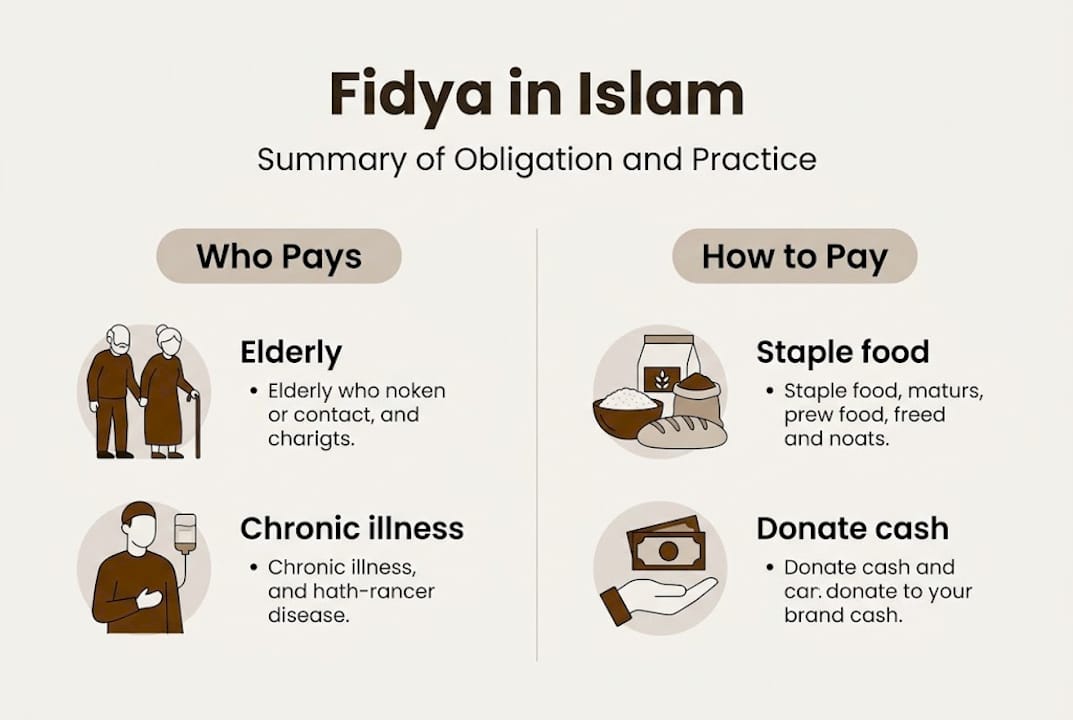
Fidya is primarily intended for:
- The elderly who are too frail to fast and will not regain the ability
- The chronically ill whose medical condition is permanent or long-term
- The terminally ill who cannot fast and have no hope of recovery
- Those with progressive conditions that make future fasting impossible
This is not a matter of preference. A person who simply dislikes fasting cannot choose fidya instead. The condition must be genuine and verified. Islamic law recognizes human vulnerability and responds with mercy, not leniency without cause. Understanding this intention is critical. Fidya preserves the spirit of worship by ensuring that even those who cannot fast are still connected to the act of giving and caring for others. This is why provisions for ill persons appear across Islamic rituals, not only in fasting.
Who must pay fidya: Eligibility, exceptions, and special cases
Understanding fidya’s purpose helps clarify who actually needs to pay it. The distinction between permanent and temporary inability is central here.
| Situation | Obligation |
|---|---|
| Permanent illness or old age | Pay fidya, no makeup fasts |
| Temporary illness or travel | Make up fasts (qada) only |
| Pregnancy or breastfeeding | Varies by madhab (school of thought) |
| Deceased person with missed fasts | Heirs may pay fidya on their behalf |
| Condition improves after paying fidya | Must still fast the missed days |
For temporary situations like illness or travel, including menstruation and recoverable pregnancy, qada (makeup fasting) is the obligation. Fidya does not apply. This is one of the most common mistakes Muslims make.
For pregnant or breastfeeding women, scholars differ:
- Hanafi: If fasting harms only the mother, only qada is required. If both mother and child are at risk, qada is still required, and fidya may be added.
- Shafi’i and Hanbali: If a woman fears harm to her child only, she pays both qada and fidya.
- Maliki: Generally, only qada is required regardless of fear for mother or child.
For a deceased person who missed fasts, heirs may pay fidya from the estate. Some scholars allow voluntary fasting on the deceased’s behalf, but fidya from the estate is widely accepted. If a person regains health after paying fidya, they must fast the missed days as well. The fidya does not cancel the fasting obligation once health returns.
Pro Tip: If you are unsure whether your situation qualifies for fidya or only qada, always consult a qualified scholar. The rules differ by madhab and personal circumstance. Being sincere is important, but accuracy matters too. Supporting charity in Ramadan alongside your fidya also magnifies your spiritual reward.
How to pay fidya correctly: Foods, amounts, and payment timing
Now that you know who owes fidya, here’s how to carry it out step by step.
Fidya requires feeding one poor person for each missed fast day, either directly with food or its monetary equivalent. The amount is based on the local staple food, typically wheat, rice, or barley.
Step-by-step guide to paying fidya:
- Count the total number of missed fast days.
- Determine the local staple food and its cost for one meal per person.
- Calculate the total: one portion of staple food (approximately 1.5 kg per day) per missed day, or the monetary equivalent.
- Choose your method: distribute food directly or donate through a reputable charity.
- Make your intention (niyyah) clearly before giving.
| Payment method | Acceptability | Notes |
|---|---|---|
| Staple food (rice, wheat, barley) | Preferred in most traditions | Distributed directly to the poor |
| Cash equivalent | Widely accepted | Charity verifies food reaches recipient |
| Giving to one person | Valid | All missed days can go to one recipient |
| Giving to multiple persons | Valid | Each receives one day’s portion |
In the US for 2026, the recommended fidya rate is $5 to $15 per missed fasting day, reflecting local food costs. Payment can be made before, during, or after Ramadan, though making it during Ramadan is preferred. Using charity rules for fidya ensures your distribution meets Islamic standards.

Pro Tip: Work with a nonprofit for distribution if you cannot distribute food yourself. Verify that the organization confirms food delivery and provides documentation. Understanding the fidya donation advantages can also motivate you to act promptly and generously.
Fidya vs. kaffarah: Key differences every Muslim should know
Many confuse fidya and kaffarah. Here’s why the distinction is crucial.
These two terms address very different situations, and using one when the other applies is a serious error.
| Feature | Fidya | Kaffarah |
|---|---|---|
| Reason | Permanent inability to fast | Deliberate breaking of fast without valid excuse |
| Amount | Feed 1 poor person per missed day | Feed 60 people or fast 60 consecutive days |
| Who owes it | Chronically ill, elderly, permanently unable | Anyone who willfully breaks a Ramadan fast |
| Replaces fasting? | Yes, when recovery is impossible | No, it’s an expiation for a violation |
The key differences at a glance:
- Fidya is a merciful substitute for those who genuinely cannot fast.
- Kaffarah is a serious expiation for deliberate violation of the fast.
- They are not interchangeable: fidya for inability (1 person per missed day), kaffarah for deliberate breaking (60 people per day or 60 consecutive fasts).
- Applying kaffarah rules when fidya is owed, or vice versa, does not fulfill the obligation correctly.
This distinction matters because the intent and the severity differ completely. Fidya acknowledges incapacity. Kaffarah addresses wrongdoing. A Muslim who accidentally breaks a fast through forgetfulness owes neither. One who breaks it deliberately and without valid excuse owes kaffarah. Understanding which applies protects your spiritual accountability. Review the donation checklist for fidya to ensure your payment meets all required conditions.
Best practices and practical tips for fulfilling fidya
Even with the basics covered, fulfilling fidya correctly requires thoughtful practical action.
Choosing a trusted organization or recipient is not a minor detail. It determines whether your fidya actually reaches a genuinely needy person, which is required for its validity.
Key practices for fulfilling fidya properly:
- Choose reputable charities that specialize in food distribution and can verify recipients are genuinely poor and eligible.
- Verify recipients whenever possible. The person or family receiving your fidya must be from those in need, not someone who is comfortable financially.
- Document your payment. Keep receipts or confirmation from the charity showing that food or its equivalent was distributed on your behalf.
- Make your niyyah (intention) clear. Before paying, state internally or verbally that this is fidya for your missed fasts.
- Act promptly. Delaying fidya unnecessarily is discouraged. The obligation exists whether Ramadan has ended or not.
For unique personal situations, consulting a local scholar is strongly recommended, especially for modern illnesses, pregnancy complications, or madhab-specific questions. Regarding amounts, food is prioritized over cash for authenticity, though monetary payments are accepted when they ensure proper distribution.
Fidya connects you to the broader tradition of humanitarian acts in Islam, reflecting mercy and collective responsibility. This sense of social responsibility runs through all Islamic obligations, not just fasting. When you pay fidya sincerely, you are supporting humanitarian efforts for those who are most vulnerable.
Our perspective: Why precision and compassion matter in fidya
There is a tendency in some communities to treat fidya casually, either paying a rough estimate without calculation or assuming any charitable act will substitute. This approach misses the point entirely.
Fidya is not simply about giving money. It is about fulfilling a specific religious obligation with the same care and intention you would bring to fasting itself. The spiritual value comes from precision combined with sincere compassion, not from convenience. When Muslims shortcut the process through cultural habit or guesswork, the spiritual accountability that Islam intends is lost.
We believe that knowing the rules well is itself an act of worship. When you understand exactly who owes fidya, what the correct amount is, and how to ensure it reaches the right person, you honor the intent behind special provisions in Islamic rites. Islam’s mercy is real, but it operates through precision, not approximation. Approach fidya with both knowledge and a sincere heart, and the obligation is fulfilled in the fullest sense.
How Badal Umrah supports your religious obligations
Fulfilling religious obligations on behalf of yourself or a loved one requires trustworthy guidance and reliable support. At Badal Umrah, we understand how important it is to carry out these duties correctly and with full confidence.

Whether you need assistance arranging Umrah by proxy for someone unable to travel or want to ensure your acts of worship are fulfilled with authenticity, our packages offer comprehensive documentation, photo and video coverage, and personalized certificates. The Umrah Badal Barakah Premium Package and the Umrah Badal Du’a Package are designed to bring peace of mind to families who want every detail handled with care and religious integrity.
Frequently asked questions
Can fidya be paid in cash, or must it be food?
Fidya is traditionally paid with staple food, but the cash equivalent is widely accepted when given through a verified channel to ensure it reaches a genuinely needy person. Food remains the preferred form in most Islamic traditions.
What amount should I pay for fidya in the US in 2026?
For 2026 in the US, the recommended fidya rate is approximately $5 to $15 per missed fasting day, calculated based on local food costs for a poor person’s daily meal.
Is there fidya for missed prayers?
There is no fidya for missed prayers; the compensation applies only to missed Ramadan fasts when qada is genuinely impossible due to permanent incapacity.
If someone pays fidya but later regains health, what must they do?
If health is restored after fidya was paid, the person must fast the missed days as well, since recovery removes the original reason fidya was accepted as a substitute.
Can fidya be given to just one poor person or must it be several?
Fidya may go to one needy person to cover all missed fasts, or it may be distributed among several recipients; Islamic scholars accept both approaches as valid.