

Best examples of Umrah photo documentation for loved ones
TL;DR:
- High-quality Umrah documentation includes clear, timestamped photos of key rituals with contextual landmarks.
- Packages range from basic step-by-step images to comprehensive video, certificates, and live updates.
- Select documentation based on circumstances to ensure emotional support, accountability, and spiritual connection.
When a loved one cannot make the journey to Makkah themselves, a well-documented Umrah performed on their behalf becomes something deeply personal. Photos from each stage of the pilgrimage offer families a way to feel present, to witness the rituals, and to find peace in knowing the duty was fulfilled with care. Yet not all photo documentation is equal. Some records are vague, poorly timed, or missing key ritual moments. This guide walks you through what good documentation looks like, how to compare your options, and how to choose the right package for your specific situation.
Table of Contents
- How to evaluate Umrah photo documentation quality
- Types of Umrah photo documentation: Step-by-step examples
- Comparing popular photo documentation packages for Umrah
- Situational recommendations: Choosing the right photo documentation
- What most miss about meaningful Umrah photo documentation
- Next steps: Trusted Umrah photo documentation for your loved ones
- Frequently asked questions
Key Takeaways
| Point | Details |
|---|---|
| Photo authenticity matters | Clear, ritual-focused photos with timestamps and recognizable landmarks provide peace of mind for families. |
| Compare package features | Consider the types of documentation—photos, video, certificates—offered by nonprofits, family organizers, or premium services. |
| Personalization counts | Request specific photo angles and coverage to ensure emotional and spiritual satisfaction for loved ones. |
| Privacy and consent | Ask providers about privacy options and distribution rules for shared Umrah documentation. |
| Trusted next steps | Premium providers offer comprehensive documentation, certification, and updates for absent loved ones. |
How to evaluate Umrah photo documentation quality
Now that you know why documentation is vital, here’s how to judge if a photo record truly meets your needs. Quality Umrah photo documentation is not just about having pictures. It’s about having the right pictures, taken at the right moments, with enough context to confirm authenticity and meaning.
Here are the core criteria to look for:
- Clarity and recognizability: Photos should clearly show the person performing the Umrah, the ritual being performed, and the surrounding environment. Blurry or distant shots reduce credibility.
- Coverage of key rituals: A complete record should include Ihram (the state of ritual purity and its attire), Tawaf (the seven circuits around the Kaaba), Sa’i (walking between Safa and Marwah), and Dua (supplication moments).
- Timestamp and location markers: Look for photos that include recognizable landmarks such as the minarets of Masjid al-Haram, directional signs, or crowd context that confirms the location and timing.
- Privacy and consent: Families and nonprofits should agree in advance on how photos are shared. Some families prefer photos sent only to immediate family, while others may share them more broadly for transparency.
As families request clearer documentation for legitimacy and emotional proof, providers are responding with more structured and thorough photo records.
When performing Umrah on behalf of others, the documentation serves a dual purpose. It confirms the ritual was completed correctly, and it gives the family something tangible to hold onto.
Pro Tip: Always ask your provider for both wide-angle shots and portrait shots. Wide-angle photos establish location and ritual context, while portrait shots confirm the identity of the person performing the Umrah. Together, they create a complete and credible record.
Types of Umrah photo documentation: Step-by-step examples
With criteria in mind, see how clear photos are structured throughout the Umrah journey. A strong photo record follows the pilgrimage from beginning to end, capturing each stage with purpose.
Here is what a thorough, step-by-step photo record looks like:
- Ihram stage: Photos taken before departure showing the white Ihram garments, a group shot if applicable, and close-up detail of the attire. These confirm the pilgrim entered the correct state of ritual purity.
- Miqat documentation: A photo at the Miqat boundary, the designated point where Ihram is assumed, with visible location landmarks such as signage or the surrounding mosque structure.
- Tawaf: Wide-angle shots showing the Kaaba and the pilgrim in the act of circumambulation. Identifying features like the Black Stone area or the green light marking the start of each circuit add credibility.
- Sa’i: Photos walking between Safa and Marwah, showing both the crowd context and the individual pilgrim. Signs marking each hill are useful visual anchors.
- Completion and Dua: Emotional highlights such as hands raised in supplication, the moment of Tahallul (exiting Ihram), and any certificate handover if included in the package.
As social responsibility in Umrah becomes a priority, nonprofits use step-by-step photo records for transparency and donor communication. This structured approach builds trust with everyone involved.
“Photo documentation builds trust with sponsors and families. When every step is recorded, there is no ambiguity about what was done and when.”
For families arranging Umrah prayers for others, this kind of organized visual record also serves as a spiritual keepsake. It connects the absent loved one to each moment of the journey in a way that words alone cannot.
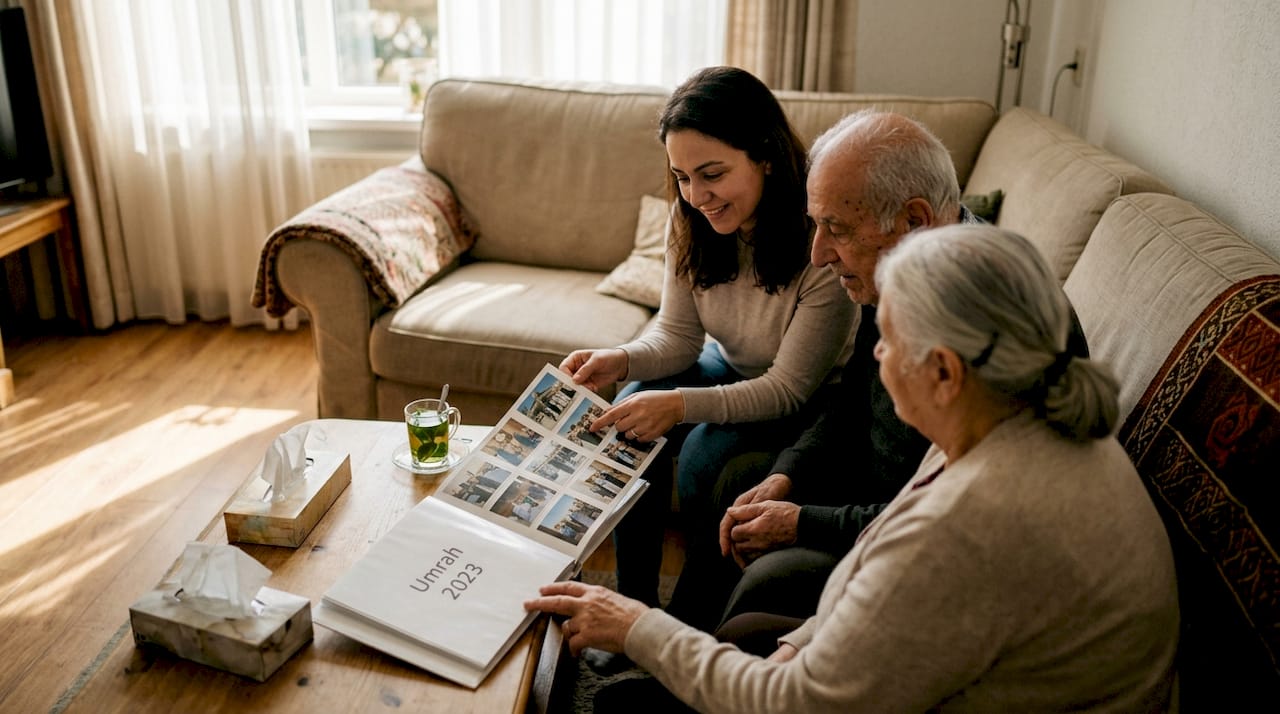
If you are coordinating documentation for a Umrah humanitarian efforts guide, step-by-step photos also help demonstrate accountability to donors and community members who contributed to the pilgrimage.
Comparing popular photo documentation packages for Umrah
Knowing the example types is helpful, but how do typical providers and packages compare? Let’s look at the three main options available to families and organizations.
| Package type | Photos included | Video | Certificate | Live updates |
|---|---|---|---|---|
| Standard nonprofit | Step-by-step ritual photos | No | No | No |
| Premium service | High-resolution, full coverage | Yes | Yes | Yes |
| Family-organized | Custom, informal shots | Optional | No | No |
Here is what each option typically offers:
- Standard nonprofit packages provide basic step-by-step photos covering each ritual. These are practical and transparent but may lack high resolution or personalized coverage.
- Premium service packages offer high-resolution photos, video documentation, live streaming options, and a personalized certificate. These are best suited for Badal Umrah (Umrah performed on behalf of a deceased or incapacitated person) where families want the most complete record possible.
- Family-organized documentation relies on personal arrangements, often resulting in informal or inconsistent coverage. Verification is limited since there is no third-party confirmation.
75% of family requests now ask for a certificate alongside photo proof, according to nonprofit documentation data. This reflects a growing expectation that photo records alone are not always sufficient for peace of mind.
Certification packages commonly include photos, video, and live updates, making premium options the most trusted choice for families who want full accountability.
For those focused on proxy faith fulfillment, understanding the difference between these packages helps you make a decision that honors both religious obligation and the emotional needs of your family.
Situational recommendations: Choosing the right photo documentation
Now, let’s turn comparison insights into specific advice for your unique circumstance. Different situations call for different levels of documentation, and choosing wisely makes a real difference.
| Situation | Recommended package | Key documentation to request |
|---|---|---|
| Elderly loved one unable to travel | Premium service | Photos, video, certificate, live updates |
| Deceased (Badal Umrah) | Premium service | Full ritual photos, certificate, Dua moment |
| Sponsored pilgrim (nonprofit) | Standard or premium | Step-by-step photos, certificate |
| Family-organized proxy | Custom arrangement | Portrait shots, ritual coverage, timestamps |
Here is a checklist of what to request based on your situation:
- For elderly loved ones: Request portrait shots at each ritual stage, a group photo if possible, and a completion certificate. Video is a meaningful bonus.
- For Badal Umrah (on behalf of the deceased): Ask for full ritual coverage, a clear Dua moment with hands raised, and a signed certificate naming the person on whose behalf the Umrah was performed.
- For sponsored pilgrims: Step-by-step photos with timestamps and a certificate are the minimum. A brief written summary of the rituals completed adds further credibility.
As step-by-step documented Badal Umrah builds confidence for sponsors and families, investing in thorough documentation is not just practical. It is an act of respect toward the person being honored.
Pro Tip: Before booking, confirm with your provider exactly which ritual moments will be photographed. Ask specifically about Tawaf, Sa’i, and the Dua completion moment. These three are the most emotionally significant for families and should never be skipped.
For caregivers navigating this process, the Umrah tips for caregivers guide offers additional practical support for arranging a smooth Badal Umrah experience.
What most miss about meaningful Umrah photo documentation
Most guides focus on technical requirements: resolution, timestamps, ritual coverage. Those things matter. But the deeper purpose of Umrah photo documentation is often overlooked.
For families who cannot be present, these photos are not just proof. They are a form of spiritual connection. A photo of hands raised in Dua at the Kaaba, taken on behalf of an elderly parent or a loved one who has passed, carries weight that no certificate can fully replace. The emotional resonance of that image is what families return to, years later.
This is why context and empathy in documentation matter as much as technical quality. A photo that captures the sincerity of the moment, the reverence of the space, and the identity of the person performing the Umrah speaks to the heart. It says: this was done with care, for your loved one, in the most sacred place on earth.
Providers who understand this produce documentation that feels like a gift, not a report. When evaluating your options, look for services that emphasize legitimate Umrah practices alongside emotional sensitivity. That combination is rare, and it is what truly serves families in their most vulnerable moments.
Next steps: Trusted Umrah photo documentation for your loved ones
If you’re ready to secure reliable photo documentation for an absent loved one, here’s where to turn next.
At Badal Umrah, every package is designed with families in mind. Documentation is not an afterthought. It is central to how we serve you.
For the most complete record, the Barakah Premium Package includes high-resolution photos, video coverage, and a personalized certificate. If you are looking for a focused, heartfelt option, the Du’a package for Umrah Badal ensures your loved one’s name is remembered in supplication with care. You can also browse all Umrah packages to find the right fit for your family’s needs and budget.
Frequently asked questions
What does a standard Umrah photo documentation package include?
Most standard packages include step-by-step photos of each ritual, with timestamps and location markers for authenticity. For more detail, certification packages commonly include photos, video, and live updates depending on the provider.
How can families confirm the authenticity of Umrah photos?
Look for recognizable landmarks, clear timestamps, and group shots with identifiable ritual context. Clarity and authenticity are the two most important factors that make Umrah photos credible for families.
Are certificates necessary if you have photo documentation?
Certificates add official verification and peace of mind, especially in Badal Umrah contexts, but detailed photos are most essential. Certification packages commonly include both photos and certificates for the strongest combined record.
What if loved ones prefer privacy? Can Umrah photos be shared selectively?
You can request providers to limit sharing and distribute photos only to authorized family members. Privacy protocols are respected in both family and nonprofit Umrah photo sharing arrangements.
Recommended
- Complete guide to Umrah prayers for others in 2026 – Badal Umrah
- Guide to performing Umrah on behalf of others in 2026 – Badal Umrah
- Why intention matters in Umrah for others: 5 key rules – Badal Umrah
- Why Umrah rites include special provisions for ill persons – Badal Umrah
- Create your wedding tradition photo list for perfect memories