

Badal Umrah religious legitimacy: a complete 2026 guide
TL;DR:
- Badal Umrah is permissible for deceased, permanently ill, elderly, or severely disabled individuals.
- Proper intent, qualified proxy, and correct ritual performance validate a legitimate Badal Umrah.
- Verification through documentation and transparent service is essential for ensuring religious legitimacy.
Many Muslims feel a quiet uncertainty when arranging Badal Umrah for a loved one: is this truly accepted in Islam, or is it simply a heartfelt gesture without real spiritual weight? The answer is neither simple nor uniform across all schools of thought, but it is absolutely knowable. Scholars have addressed this question for centuries, and their guidance gives families a clear path forward. This guide walks you through the core criteria, the major scholarly positions, and the practical steps you need to follow so that the Badal Umrah you arrange carries genuine religious legitimacy and brings real peace of mind.
Table of Contents
- What is Badal Umrah and who can request it?
- Scholarly opinions: How major Islamic schools view Badal Umrah
- Essential requirements: How to ensure your Badal Umrah is religiously valid
- How to avoid doubt: Verification and documentation of Badal Umrah
- Our view: What families often overlook about Badal Umrah legitimacy
- How to arrange a legitimate Badal Umrah with confidence
- Frequently asked questions
Key Takeaways
| Point | Details |
|---|---|
| Proxy allowed with conditions | Badal Umrah is religiously accepted for the deceased and, with specific conditions, for the incapacitated living. |
| Scholarly consensus and nuances | Major scholars agree on basic legitimacy but have different requirements, especially for the living. |
| Proper intention is key | Declaring the correct intention and following all Umrah rituals are vital for religious validity. |
| Verification brings peace | Requesting documentation and choosing reputable providers helps assure your family’s spiritual fulfillment. |
What is Badal Umrah and who can request it?
Badal Umrah is the practice of performing Umrah on behalf of another person who is unable to do so themselves. The word badal means substitute or replacement in Arabic, and the concept rests on the Islamic principle that sincere acts of worship performed with proper intention can benefit another Muslim. Understanding the Badal Umrah meaning in full helps families approach the process with the right expectations from the start.
The foundational legitimacy of Badal Umrah comes from scholarly consensus, known as Ijma, particularly regarding deceased Muslims. For those who have passed away without completing Umrah, there is broad agreement across the major schools that a proxy may perform it on their behalf. The situation for living persons is more nuanced and depends on specific conditions being met.
Who qualifies to have Badal Umrah performed on their behalf? The scholarly consensus recognizes the following categories:
- Deceased Muslims who intended to perform Umrah but passed away before doing so
- Permanently ill individuals who have no realistic hope of recovery and cannot travel
- Elderly persons who are physically incapable of making the journey due to extreme old age
- Those with severe disabilities that prevent them from fulfilling the rituals themselves
It is important to note that temporary illness or financial hardship alone does not typically qualify a living person for Badal Umrah. The incapacity must be genuine and, in most scholarly views, permanent or long-term. Families should approach this honestly and not use Badal Umrah as a shortcut for someone who is simply unwilling or temporarily unable to travel.
The person requesting Badal Umrah also carries responsibilities. They should make their intention clear to the proxy, provide the correct full name of the person on whose behalf Umrah is being performed, and ensure they choose a trustworthy and qualified individual or service. The sincerity of the requester matters as much as the execution of the rituals.
Scholarly opinions: How major Islamic schools view Badal Umrah
Let’s explore how the four major schools of Islamic jurisprudence understand the legitimacy of Badal Umrah. While they share a common foundation, their specific conditions differ in meaningful ways. Understanding these differences helps you make an informed decision based on your own tradition.
The rulings on proxy Umrah vary across schools, but there is more agreement than disagreement at the core level. All four schools accept Badal Umrah for the deceased. The divergence appears primarily around living persons and the qualifications of the proxy.
| School | Deceased | Living (incapable) | Proxy must do own Umrah first |
|---|---|---|---|
| Shafi’i | Permitted | Permitted (permanent incapacity) | Yes, required |
| Hanbali | Permitted | Permitted (permanent incapacity) | Yes, required |
| Hanafi | Permitted | Permitted (incapacity) | Allowed before, but disliked |
| Maliki | Permitted | Restricted, stricter conditions | Less emphasized |
The Shafi’i and Hanbali schools are the most permissive for living persons, provided the incapacity is permanent. Both schools also require the proxy to have completed their own Umrah before performing it on behalf of someone else. This condition is considered a prerequisite for validity in these two schools.
The Hanafi school permits Badal Umrah for incapable living persons as well, but takes a slightly different view on the proxy’s prior experience. A proxy who has not yet performed their own Umrah may still act as a substitute, though scholars within this school consider it disliked (makruh) rather than outright invalid.
The Maliki school is the most cautious regarding living persons. It places greater emphasis on Badal Umrah for the deceased and imposes stricter conditions when it comes to those still living. Families following the Maliki tradition should consult a qualified scholar before proceeding for a living relative.
For most readers, the Shafi’i and Hanbali positions will be most relevant, as these are widely followed across South and Southeast Asia, the Gulf, and many Western Muslim communities. You can review the full Islamic rulings on Badal Umrah to understand which position applies to your situation.
Essential requirements: How to ensure your Badal Umrah is religiously valid
Understanding the scholarly debate is critical, but what steps must actually be followed to ensure a religiously complete Badal Umrah in practice? The answer lies in both the qualification of the proxy and the correct performance of each ritual.
Here is a numbered breakdown of the essential requirements according to the majority scholarly view:
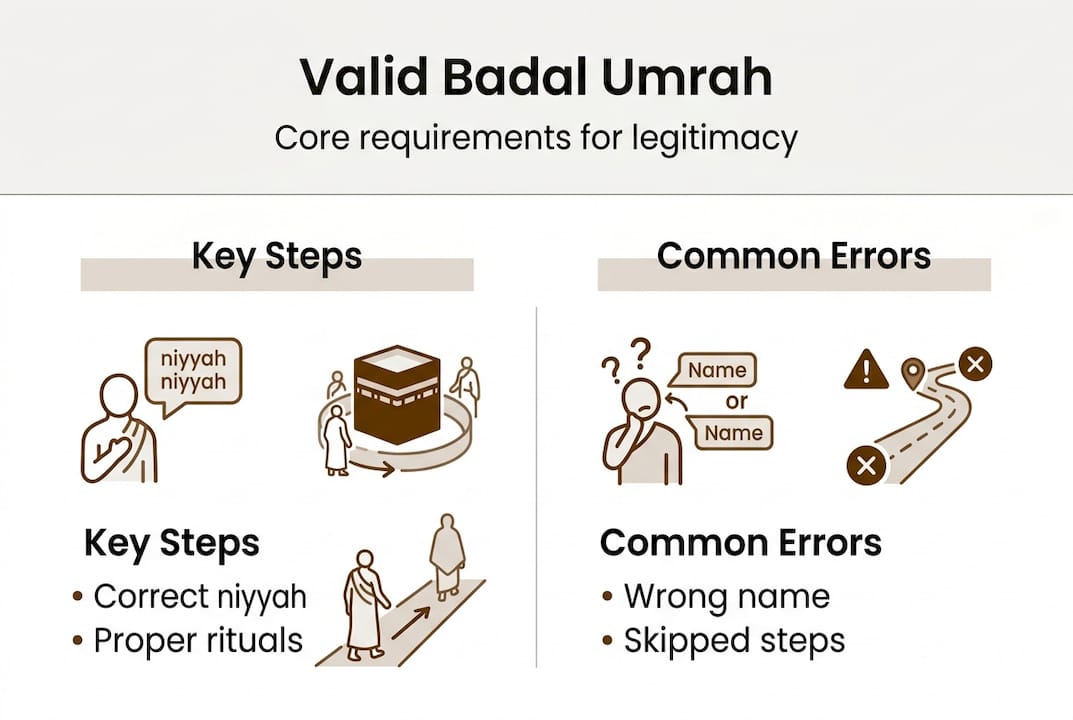
- Confirm the person’s eligibility. The individual on whose behalf Umrah is being performed must genuinely qualify, whether deceased, permanently ill, or severely incapacitated.
- Select a qualified proxy. According to the majority view held by Shafi’i and Hanbali scholars, the proxy must have already completed their own Umrah before acting on behalf of another.
- Declare the correct niyyah (intention). The required intention is: Nawaitul 'umrata 'an [name] wa ahramtu bihaa lillahi ta’ala, meaning “I intend Umrah on behalf of [name] and I enter Ihram for it for the sake of Allah.”
- Enter Ihram correctly. Ihram is the sacred state of ritual purity and intention, marked by specific clothing and the declaration of intention. It must be entered at the designated Miqat (boundary point).
- Complete Tawaf. The proxy performs seven circuits around the Kaaba, all on behalf of the intended person.
- Perform Sa’i. This involves walking seven times between the hills of Safa and Marwa, following the Sunnah of Hajar.
- Complete Halq or Taqsir. The proxy shaves or shortens their hair, marking the completion of the Umrah rituals and the exit from Ihram.
You can follow the full step-by-step Badal Umrah process for a detailed walkthrough of each stage.
Common mistakes that can undermine religious validity include declaring the wrong name in the niyyah, skipping or incorrectly performing any of the core rituals, or having the proxy enter Ihram at the wrong location. These errors can affect whether the Umrah counts as complete.
Pro Tip: Always provide the proxy with the full name of your loved one before the Umrah begins. A small detail like a misspelled or incomplete name in the niyyah can create unnecessary doubt. Confirm it in writing.
Families requesting Badal Umrah should also stay in contact with the service provider throughout the process. The full Badal Umrah guide covers additional practical considerations for families arranging this from abroad.
How to avoid doubt: Verification and documentation of Badal Umrah
Once the requirements are clear, how can you be certain that Badal Umrah was actually performed correctly and how do you document it? This is where many families feel the most uncertainty, especially when arranging the service remotely from another country.
Verification is not just a practical concern. It is also a matter of spiritual peace of mind. When you know the Umrah was performed correctly, you can rest assured that the religious obligation has been fulfilled with sincerity and care.
Here is what to look for when evaluating a Badal Umrah service provider:
| Verification type | What it confirms | Why it matters |
|---|---|---|
| Personalized certificate | Official record of Umrah performed | Provides lasting documentation |
| Photo coverage | Visual confirmation of rituals | Confirms presence at holy sites |
| Video documentation | Real-time or recorded evidence | Highest level of transparency |
| Correct niyyah confirmation | Proxy stated the right intention | Core religious requirement met |
| Ritual completion report | All steps completed in order | Ensures no step was skipped |
The required rituals of Ihram, Tawaf, Sa’i, and Halq/Taqsir must all be documented and verifiable. A trustworthy provider will confirm each stage clearly, not just issue a certificate without supporting evidence.
Pro Tip: Before booking any service, ask specifically whether they provide video evidence of the Tawaf and Sa’i. These are the two most visually confirmable rituals, and a reputable provider will have no hesitation offering this.
When verifying Badal Umrah legitimacy, also check that the provider confirms the proxy’s qualifications. Ask whether the person performing the Umrah has completed their own first. A transparent provider will answer this directly.
Documentation also serves a longer-term purpose. Families often want to keep a record as part of their loved one’s spiritual legacy. A certificate, photo, or video is not just proof. It is a meaningful keepsake that honors the person on whose behalf the Umrah was performed. The guide for fulfilling Badal Umrah offers further advice on how to approach this process with the care it deserves.
Our view: What families often overlook about Badal Umrah legitimacy
After working through the process and verification steps, it is worth pausing to reflect on what truly determines religious legitimacy. In our experience, families sometimes focus so much on finding a provider that they overlook the two things that matter most: the sincerity of the intention and the qualification of the proxy.
A beautifully designed certificate means very little if the niyyah was declared incorrectly or the proxy had never performed their own Umrah. Formal compliance without genuine care is not enough. At the same time, pure intention without proper ritual execution also falls short.
The most common pitfall we see is families choosing providers based on price alone, without asking the right questions about how the service is conducted. Religious legitimacy is not guaranteed by a low price or a polished website.
Our sincere advice: consult a trusted scholar in your community before booking, confirm the proxy’s qualifications directly, and choose a provider who is transparent about every step. Fulfilling the sacred duty of Badal Umrah for a loved one is an act of deep love. It deserves the same careful attention you would give to any important religious obligation.
How to arrange a legitimate Badal Umrah with confidence
With clarity on what ensures religious legitimacy, here is how to confidently arrange a truly valid Badal Umrah for your loved one.
At badalumrah.org, every service is built around religious compliance, transparency, and genuine care. Each booking includes a personalized certificate, photo and video documentation of the rituals, and confirmation that the proxy has completed their own Umrah first. You can explore the premium Badal Umrah package for the most complete offering, or browse all Umrah packages to find the right fit for your family’s needs and budget. A portion of every booking supports humanitarian relief in Gaza, so your act of worship also extends compassion to those in need.
Frequently asked questions
Is Badal Umrah valid for someone who is still alive?
Yes, if the living person is truly unable to perform Umrah due to permanent illness or extreme old age, most scholars allow it. The scholarly consensus permits this with conditions, though the Maliki school applies stricter requirements than the others.
Can anyone act as a proxy for Badal Umrah?
No. The proxy must have completed their own Umrah first according to the Shafi’i and Hanbali schools, which represent the majority view. The Hanafi school permits it before, but considers it disliked.
What is the required intention (niyyah) for Badal Umrah?
The essential niyyah is Nawaitul 'umrata 'an [name], declared at the Miqat when entering Ihram, followed by the complete performance of all Umrah rituals on behalf of the intended person.
How can I verify that Badal Umrah was completed for my family member?
Request documentation such as a personalized certificate, photos, and video evidence from the service provider. A reputable provider will also confirm the correct rituals were completed in the proper order and with the correct intention.