

Badal Umrah guide for families: fulfill the sacred duty
When a parent grows too frail to travel, or a sibling’s illness makes the journey to Makkah impossible, the weight of an unfulfilled religious duty can rest heavily on a family’s heart. Badal Umrah, the practice of performing Umrah on behalf of another person, offers a meaningful and religiously valid path forward. This guide walks you through everything your family needs to know, from understanding the Islamic basis of Badal Umrah to selecting a trustworthy provider, completing the ritual correctly, and verifying that it was done with full integrity.
Table of Contents
- Understanding Badal Umrah: Meaning and the religious basis
- Essential requirements and who can perform Badal Umrah
- Preparing for Badal Umrah: Documents and trusted service selection
- Step-by-step process: Fulfilling Badal Umrah for your loved one
- Verifying completion: Valid proof and avoiding pitfalls
- How Badal Umrah services help families fulfill their obligation
- Frequently asked questions
Key Takeaways
| Point | Details |
|---|---|
| Badal Umrah eligibility | Performer must be an adult Muslim who has completed their own Umrah and is capable mentally and physically. |
| Proper intention required | Stating the intention for the specific person is essential for religious validity. |
| Documentation for proof | Certificates and multimedia evidence provide families assurance and facilitate verification. |
| Choose trusted providers | Select reputable services with clear evidence and religious compliance for peace of mind. |
| Step-by-step process | Families can follow a checklist to ensure every aspect of Badal Umrah is fulfilled correctly. |
Understanding Badal Umrah: Meaning and the religious basis
The meaning of Badal Umrah is straightforward: one qualified Muslim performs the Umrah pilgrimage on behalf of another person who is unable to do so themselves. The word “Badal” means substitute or replacement in Arabic. This practice holds a unique and honored position in Islamic jurisprudence.
Badal Umrah is permitted for two categories of people. First, living individuals who face a permanent or long-term inability to travel due to serious illness, extreme old age, or severe disability. Second, deceased Muslims for whom Umrah was never completed during their lifetime. The Islamic rulings on Badal Umrah confirm that the majority of scholars accept this practice under specific conditions.
The religious intention, known as niyyah, is the cornerstone of any valid Badal Umrah. The performer must sincerely dedicate the entire act of worship to the person on whose behalf it is being done. Without a clear and correct niyyah, the ritual does not count.
Regarding the positions of the major Islamic legal schools, Fiqh schools including Hanafi, Shafi’i, and Hanbali permit Badal Umrah with specific conditions, while the Maliki school takes a more restrictive stance. Families should be aware of which scholarly opinion their household follows.
The spiritual rewards of Badal Umrah extend to both the performer and the person on whose behalf it is done. Allah, in His mercy, accepts sincere acts of worship performed with the right intention, and the family earns reward for facilitating this act of devotion.
Key eligibility points for Badal Umrah:
- The person on whose behalf Umrah is performed must be genuinely unable to travel
- For a living person, the inability must be permanent or long-term, not temporary
- For a deceased person, there is no restriction on timing
- The rules on Umrah for others require that the request comes from a family member or authorized representative
“Performing Umrah on behalf of another is an act of love and devotion. It carries the weight of sincere intention and the hope of divine acceptance for both the giver and the recipient.”
Now that you understand why Badal Umrah is essential for families, let’s look at the requirements you need to meet before the process can begin.
Essential requirements and who can perform Badal Umrah
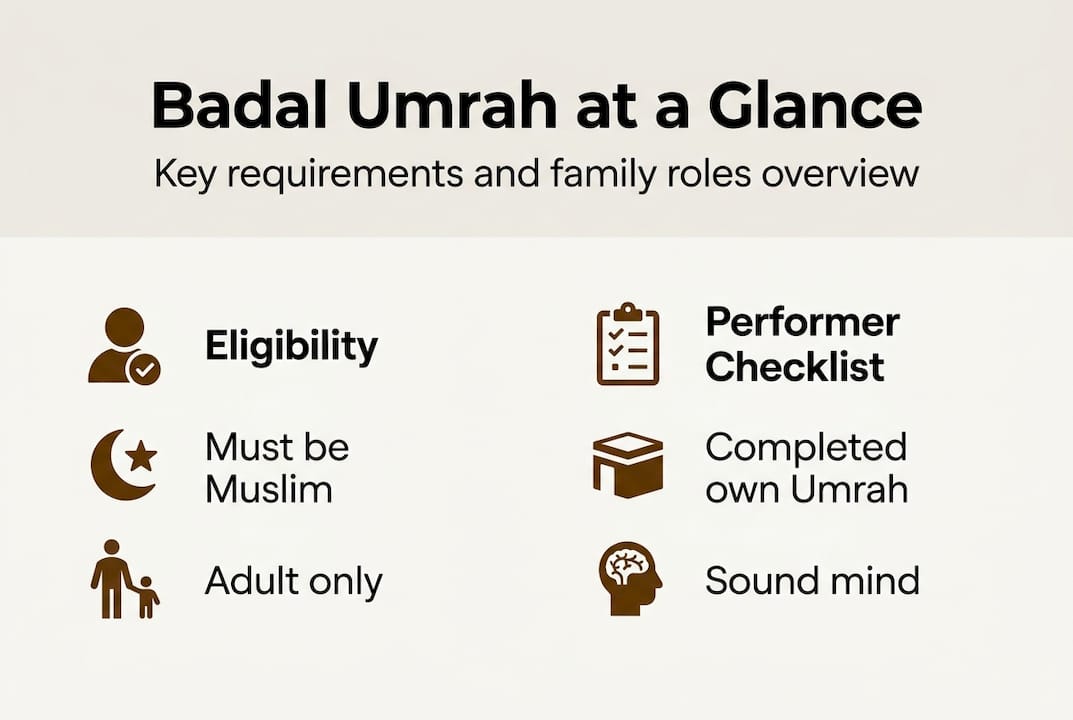
Not every Muslim can step forward as a performer for Badal Umrah. There are clear religious prerequisites that must be satisfied. According to established Islamic guidance, the performer must be Muslim, adult, sane, have completed their own Umrah previously, and make a specific intention naming the person on whose behalf the Umrah is being performed.
These requirements exist to protect the integrity of the ritual. A person who has never performed Umrah for themselves cannot be expected to correctly fulfill it for another.
Performer requirements at a glance:
| Requirement | Details |
|---|---|
| Religion | Must be Muslim |
| Age | Must be an adult (baligh) |
| Mental state | Must be sane and of sound mind |
| Prior Umrah | Must have completed own Umrah first |
| Intention | Must name the person on whose behalf Umrah is done |
Regarding who can request Badal Umrah, immediate family members such as spouses, children, parents, and siblings are the most common requesters. Legal heirs and authorized guardians may also arrange it. The responsibility for ensuring the performer meets all qualifications rests with both the requester and the performer.
Families should also confirm that the performer’s own Umrah was completed correctly. This is a step many overlook. Checking the detailed performer qualifications before finalizing any arrangement is strongly advised.
Pro Tip: Before confirming any performer or service, ask directly whether the performer has completed their own Umrah and request any available documentation. This single step prevents the most common eligibility errors.
Once you’ve ensured eligibility, it’s crucial to prepare all details before the sacred journey begins.
Preparing for Badal Umrah: Documents and trusted service selection
Good preparation makes the difference between a smooth, spiritually valid Badal Umrah and one filled with uncertainty. Families need to gather a few key documents before the process begins.
Essential documents to prepare:
- Identity proof for both the requester and the person on whose behalf Umrah is being performed
- A written statement of intent, clearly naming the person and the purpose
- Any medical documentation confirming the person’s inability to travel, if applicable
- A certificate or record of the performer’s own completed Umrah
Choosing a trustworthy provider is equally important. Look for services that are transparent about their packages, provide clear religious compliance statements, and offer documentation upon completion. A guide to choosing trusted Umrah packages can help families evaluate their options carefully.
What to confirm with a provider before payment:
- Confirm the performer’s qualifications and prior Umrah completion
- Ask for a written breakdown of all rituals included in the package
- Verify that the correct niyyah will be made, specifically: “Nawaitul 'umrata 'an [name] wa ahramtu bihaa lillahi ta’ala”
- Request the format and timeline for receiving proof of completion
- Check whether the provider offers any religious compliance guarantee
Comparison: In-person representative vs. service provider
| Factor | In-person representative | Service provider |
|---|---|---|
| Accountability | Personal relationship | Contractual agreement |
| Documentation | Often informal | Structured certificates and media |
| Verification | Relies on trust | Photos, videos, certificates |
| Accessibility | Limited by geography | Available worldwide |
Pro Tip: Always request video or photo evidence of the Tawaf (circling the Kaaba) and Sa’i (walking between Safa and Marwa), along with a completion certificate. These records give your family lasting peace of mind and serve as a permanent record. Families can also review Umrah tips for caregivers for additional practical guidance.
With your documents gathered and provider chosen, here’s how your family’s Badal Umrah will actually unfold, step by step.
Step-by-step process: Fulfilling Badal Umrah for your loved one
Understanding each stage of the ritual helps families follow along and verify that everything was done correctly. Here is the complete process from start to finish.
Steps for performing Badal Umrah:
- Enter the state of Ihram: The performer puts on the Ihram garments and makes the intention at the Miqat (the designated boundary point). This is the most critical step.
- Recite the correct niyyah: The intention must specifically name the person on whose behalf Umrah is being performed.
- Perform Tawaf: The performer circles the Kaaba seven times in a counterclockwise direction.
- Pray two Rak’ahs: After Tawaf, two units of prayer are offered near Maqam Ibrahim.
- Perform Sa’i: The performer walks seven times between the hills of Safa and Marwa.
- Complete Tahallul: The performer shaves or cuts their hair, marking the end of the Ihram state.
- Make a final Dua: A sincere supplication is offered for the person on whose behalf the Umrah was performed.
The correct intention is the foundation of the entire ritual. Without it, the Umrah is not valid for the intended person.
“Nawaitul 'umrata 'an [Name of person] wa ahramtu bihaa lillahi ta’ala.” Translation: “I intend to perform Umrah on behalf of [Name] and I enter into the state of Ihram for the sake of Allah.”
The most common mistakes in Badal Umrah involve an unclear niyyah, skipping or shortening the Sa’i, or failing to document completion. Families should review the step-by-step Badal Umrah guide to understand each checkpoint. According to Islamic guidance, the performer must be Muslim, adult, sane, and make the correct intention naming the specific person, as this is what validates the entire act of worship.
It’s equally important to know what to expect after completion, and how your family can verify everything was done with full integrity.
Verifying completion: Valid proof and avoiding pitfalls
Once the Badal Umrah is complete, families deserve clear confirmation. Verification is not about distrust. It is about honoring the seriousness of the obligation and ensuring the loved one’s right has been fulfilled.
Acceptable forms of proof include:
- A personalized completion certificate bearing the name of the person on whose behalf Umrah was performed
- Photographs taken during Tawaf and Sa’i
- Video footage of key ritual stages
- A written report from the performer or service provider detailing each step completed
Families should review a comprehensive guide for performing Umrah on behalf of others in 2026 to understand what documentation standards are currently expected.
If a service provider does not supply adequate proof, families have every right to raise the concern directly. Contact the provider in writing, request the missing documentation, and if necessary, consult a local Islamic scholar to assess whether the ritual was completed validly based on the information available.
Checklist for confirming fulfillment:
- Completion certificate received and reviewed
- Performer’s name and qualifications confirmed
- Niyyah wording verified as correct
- Tawaf and Sa’i documented with photos or video
- Final Dua made on behalf of the loved one
Pro Tip: Store both digital and physical copies of all proof documents in your family records. These records carry spiritual and sentimental value and may be referenced by future generations.
Armed with this understanding, families can approach Badal Umrah confidently, knowing their efforts secure both spiritual peace and practical assurance.
How Badal Umrah services help families fulfill their obligation
For many families, arranging Badal Umrah independently can feel overwhelming, especially when navigating religious requirements, performer qualifications, and documentation from abroad. Specialized services exist precisely to carry this responsibility with care and transparency.

At badalumrah.org, families can access structured packages designed to meet every requirement outlined in this guide. The Umrah Badal Barakah Premium Package includes a qualified performer, a personalized completion certificate, and photo and video documentation of the ritual. Every package is built around religious compliance, so your family can trust that the niyyah, Tawaf, Sa’i, and Tahallul are all completed correctly and with sincerity. Browsing the full range of full Umrah packages allows families to find the option that best fits their needs and budget. Additionally, 10% of every booking supports humanitarian efforts in Gaza, meaning your act of worship also extends compassion to those in need.
Frequently asked questions
Can Badal Umrah be performed for someone who is still alive?
Yes, most scholars allow Badal Umrah for living people who are chronically ill or elderly and cannot travel. The Hanafi, Shafi’i, and Hanbali schools all permit this under specific conditions, while the Maliki school is more restrictive.
What is the correct intention (niyyah) for Badal Umrah?
The intention must specifically name the person on whose behalf Umrah is being performed. The accepted wording is “Nawaitul 'umrata 'an [Name]”, followed by entering Ihram for the sake of Allah.
Who can act as the performer for Badal Umrah?
Any sane, adult Muslim who has completed their own Umrah and meets the religious guidelines may perform Badal Umrah on behalf of another person.
Is documentation required for Badal Umrah to be valid?
Documentation is not a religious requirement for validity, but certificates, photos, or videos are strongly advised for families seeking confirmation and peace of mind, especially when using a service provider.