

What Is Badal Umrah? Rules, Eligibility, And How It Works
When a loved one passes away without completing Umrah, or when illness or old age makes the journey to Mecca impossible, many Muslims ask the same question: what is Badal Umrah, and can someone else perform this pilgrimage on their behalf? The short answer is yes, and it's a practice rooted in authentic hadith and supported by scholars across major schools of Islamic jurisprudence.
But the details matter. Not every situation qualifies, the rules differ depending on the school of Fiqh you follow, and the process itself has specific conditions that must be met for the Umrah to be accepted. Understanding these distinctions is essential before you move forward, whether you plan to perform Badal Umrah yourself or hire someone to do it on your behalf.
This article breaks down the definition, the scholarly rulings on eligibility, and the step-by-step process of how Badal Umrah works. At Badal Umrah, this is exactly what we do, we connect families with dedicated performers in Mecca who carry out the pilgrimage on behalf of those who can't, with full documentation and personalized du'ā. Everything we cover here reflects the same principles that guide our service.
What badal Umrah means and when it applies
The word "Badal" (بدل) in Arabic means substitute or replacement. So when you ask what is Badal Umrah, the answer is direct: it is the performance of Umrah by one person on behalf of another. The person making the journey acts as a stand-in, setting the intention (niyyah) specifically for the beneficiary before entering ihram. The spiritual reward of the pilgrimage goes to the person it is performed for, not to the performer.
The performer dedicates the entire act of worship to the beneficiary from the moment they make their intention, which is what gives Badal Umrah its legal and spiritual validity.
Who the beneficiary typically is
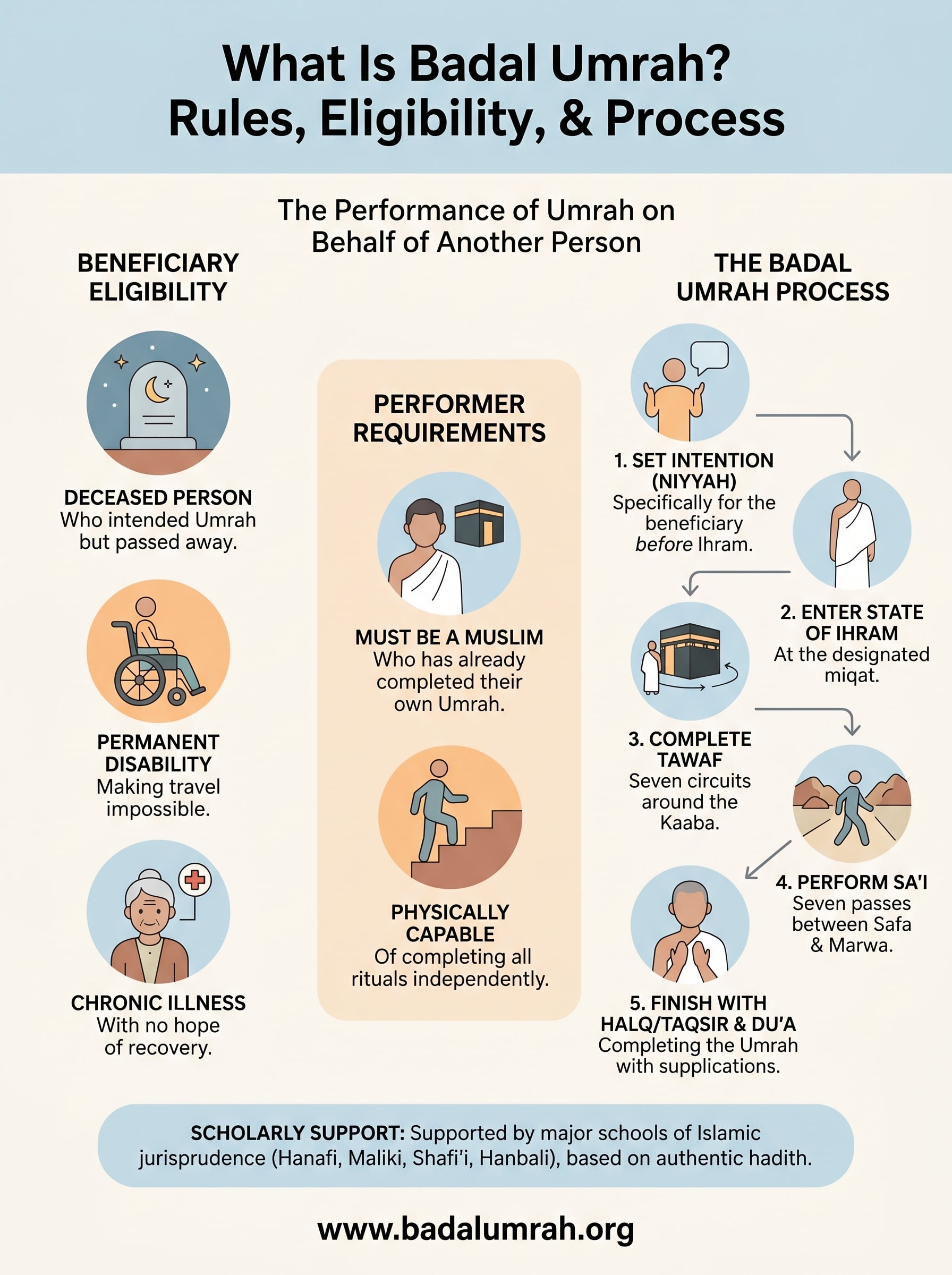
In most cases, the beneficiary falls into one of three categories. The first is a deceased person who intended to perform Umrah during their lifetime but passed away before they had the chance. The second is someone who is chronically ill with no realistic hope of recovering enough to travel. The third is a person with a permanent physical disability that makes the journey to Mecca impossible. These are the situations where the vast majority of scholars agree that delegating the pilgrimage to someone else is both valid and spiritually meaningful.
What separates it from a voluntary act
It is worth clarifying that Badal Umrah is not the same as one person simply performing Umrah and then gifting the reward to a loved one. In Badal Umrah, the intention is set on behalf of another person from the very beginning, before the state of ihram begins. Your role as the one commissioning the service, whether you perform it yourself or hire a dedicated performer, is to ensure that the correct name and intention are established before the rituals start. This distinction matters because it is what makes the act legally binding as a substitution rather than just a personal deed.
Is badal Umrah allowed in Islam
Yes, Badal Umrah is permitted in Islam, and scholars have upheld this position for centuries. The primary evidence comes from an authenticated hadith in which a woman asked the Prophet Muhammad (peace be upon him) whether she could perform Hajj on behalf of her elderly father who could not ride. He confirmed she could, and scholars extended this ruling to Umrah by analogy. All four major schools of Islamic jurisprudence (Hanafi, Maliki, Shafi'i, and Hanbali) accept the permissibility of performing pilgrimage on behalf of another, though they differ on specific conditions.
The foundational hadith supporting proxy pilgrimage is classified as sahih (authentic) and serves as the direct textual basis across all four major schools.
Where the schools agree and where they differ
Understanding what is Badal Umrah from a Fiqh perspective means recognizing where scholarly consensus exists and where it does not. All four schools agree that Umrah can be performed on behalf of a deceased person. The disagreements center on living beneficiaries: some schools require a permanent inability to travel, while others allow delegation under broader circumstances.
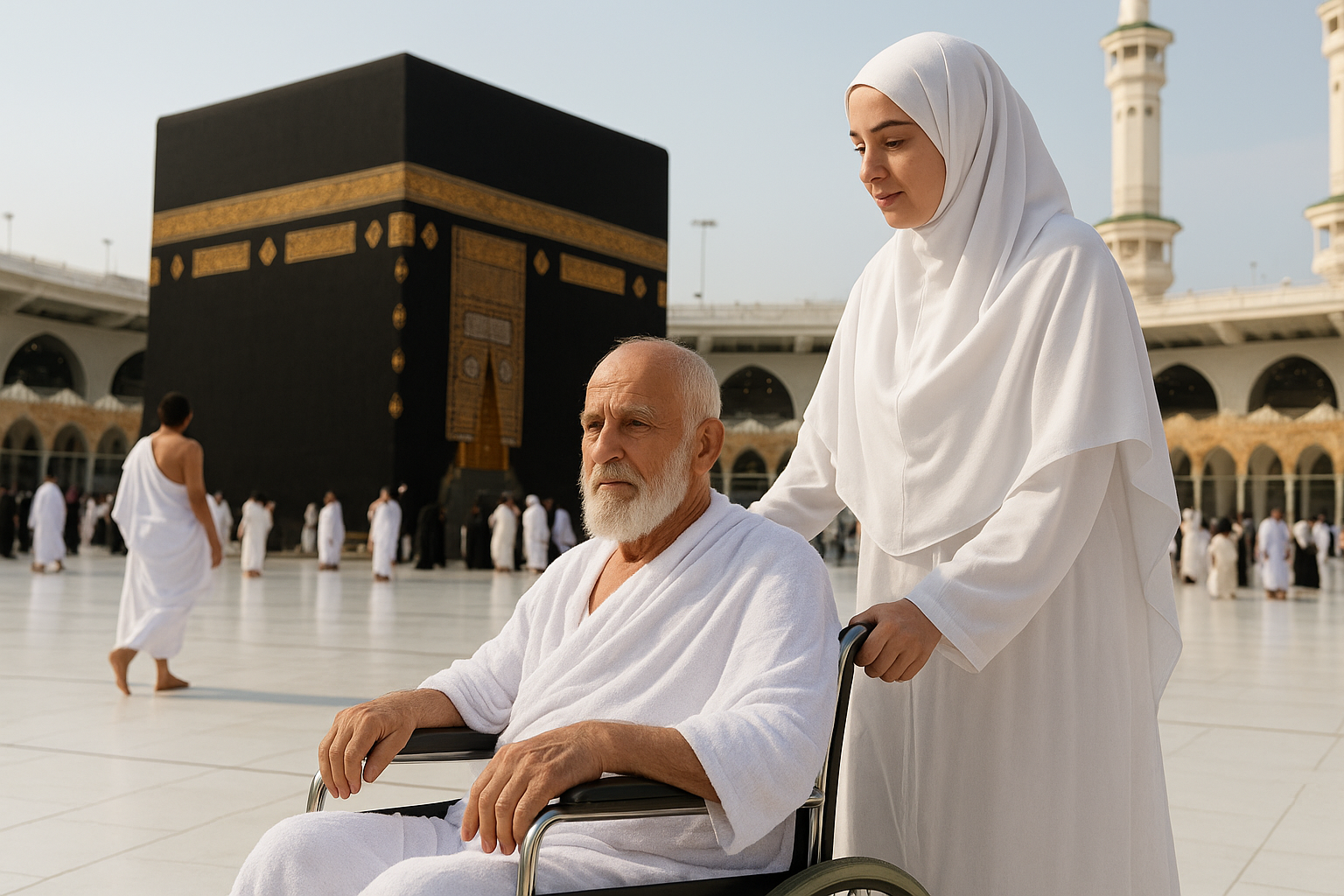
Here is a summary of the key positions:
- Hanafi and Hanbali: Permit it for the deceased and for those with a permanent physical inability
- Shafi'i: Allows it for the deceased and those with chronic illness or disability
- Maliki: Primarily recognizes it for the deceased, with stricter conditions for the living
Who can perform it and who can receive it
Understanding who qualifies on each side of the arrangement is just as important as understanding what is Badal Umrah itself. Both the performer and the beneficiary must meet specific conditions for the pilgrimage to carry full validity, and overlooking either set of requirements can compromise the act.
Who qualifies to perform Badal Umrah
The person you choose to perform Badal Umrah must be a Muslim who has already completed their own Umrah at least once before taking on someone else's. Scholars across all major schools hold that a person who has not yet fulfilled their own obligation should not substitute for another. Beyond that, the performer must be physically capable of completing every single ritual independently, without requiring a proxy themselves.
Completing your own Umrah first is a prerequisite that scholars across all four major schools consistently require before performing it on behalf of another.
Who can receive Badal Umrah
The most widely accepted beneficiary is a deceased Muslim who intended to perform Umrah during their lifetime but passed away before the opportunity came. For living beneficiaries, scholars require a permanent condition such as chronic illness or physical disability that makes travel to Mecca genuinely impossible. Temporary situations like short-term sickness or a financial shortfall generally do not meet the threshold.
Accepted categories of beneficiaries include:
- A Muslim who passed away before performing Umrah
- A person with a permanent physical disability
- Someone with a chronic illness that prevents travel indefinitely
How badal Umrah is performed step by step
Knowing what is Badal Umrah is one thing, but understanding the actual sequence of rituals is what ensures the pilgrimage is carried out correctly. The process follows the same physical steps as a standard Umrah, with one critical difference: every action is dedicated to the beneficiary from start to finish.
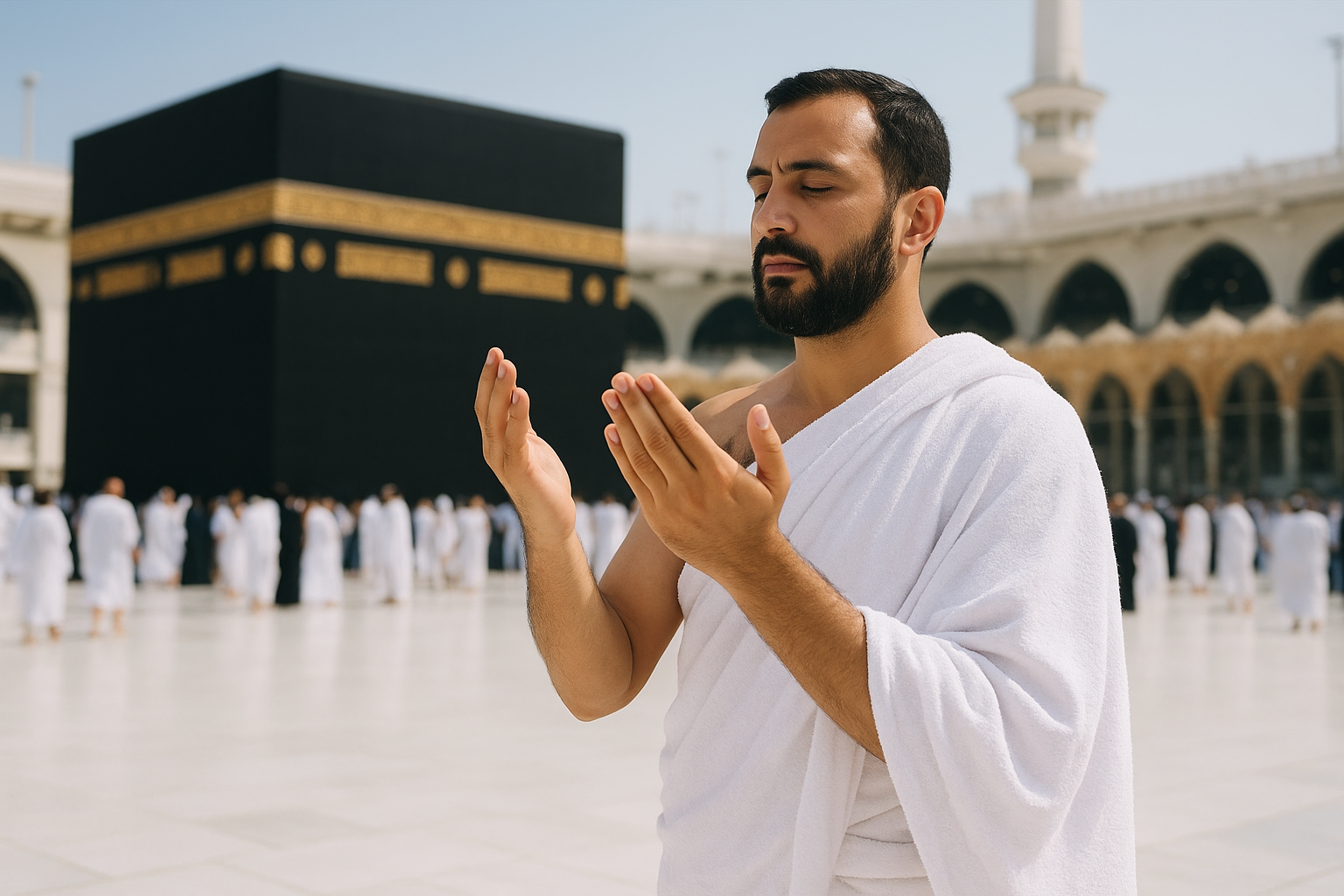
Setting the intention before ihram
The performer enters a state of ritual purity and wears the ihram garments at the designated miqat (entry boundary for Mecca). Before beginning, they state the niyyah out loud, explicitly naming the person on whose behalf the Umrah is being performed. This verbal intention is the single most important step in the entire process because it establishes the legal substitution.
Without a clearly stated intention naming the beneficiary before ihram begins, the Umrah defaults to the performer's own act of worship.
Completing the rituals in sequence
Once in ihram, the performer carries out each rite in order:
- Tawaf: Seven counterclockwise circuits around the Kaaba
- Sa'i: Seven passes between the hills of Safa and Marwa
- Halq or Taqsir: Shaving or shortening the hair to exit ihram
- Du'a: Personalized supplications made on behalf of the beneficiary throughout
Each ritual must be completed in full with no shortcuts. The performer exits ihram only after finishing all steps, at which point the Umrah is considered complete for the beneficiary.
How a badal Umrah service works
Once you understand what is Badal Umrah and confirm that your situation qualifies, the next practical step is arranging for it to be performed. A professional service handles the assignment of a qualified performer, the coordination in Mecca, and the delivery of documentation so you have clear evidence the pilgrimage was completed correctly.
Selecting a service that provides media and a completion certificate gives you a tangible record that the Umrah was performed with the correct intention and finished in full.
What you get when you book
When you place a booking, you provide the name of the beneficiary and your chosen service package. A dedicated performer is then assigned to carry out the Umrah specifically for your loved one. Your booking typically includes photo and video documentation of the rituals, a completion certificate, and personalized du'a made throughout the performance on behalf of the beneficiary.
What happens after the Umrah is complete
After the performer finishes all rituals, you receive your documentation and media files according to the delivery timeframe of your selected package. Some packages also include a live broadcast option so you can follow along in real time. The Umrah completion certificate is issued once everything is verified, giving your family formal acknowledgment that the obligation has been fulfilled for your loved one.
Final thoughts
Understanding what is Badal Umrah gives you the foundation to make a decision grounded in both religious knowledge and practical clarity. The practice is valid across all four major schools of Islamic jurisprudence, the eligibility conditions are clear, and the rituals follow the same sequence as a standard Umrah with one defining difference: the intention is set entirely for your loved one from the very start.
Your next step is finding a performer who meets the scholarly requirements, completes every ritual in full, and provides you with documentation you can hold on to. That combination of religious integrity and transparent delivery is exactly what makes the difference between uncertainty and peace of mind.
If you are ready to fulfill this obligation for someone who could not make the journey themselves, book a Badal Umrah service and have a dedicated performer carry out the pilgrimage on behalf of your loved one, with full documentation and personalized du'a throughout.