- zamzam for beneficiary
Zamzam for the Beneficiary of Umrah: Intention and Naming
Published on Nov 27, 2026

Zamzam for the Beneficiary of Umrah: Intention and Naming
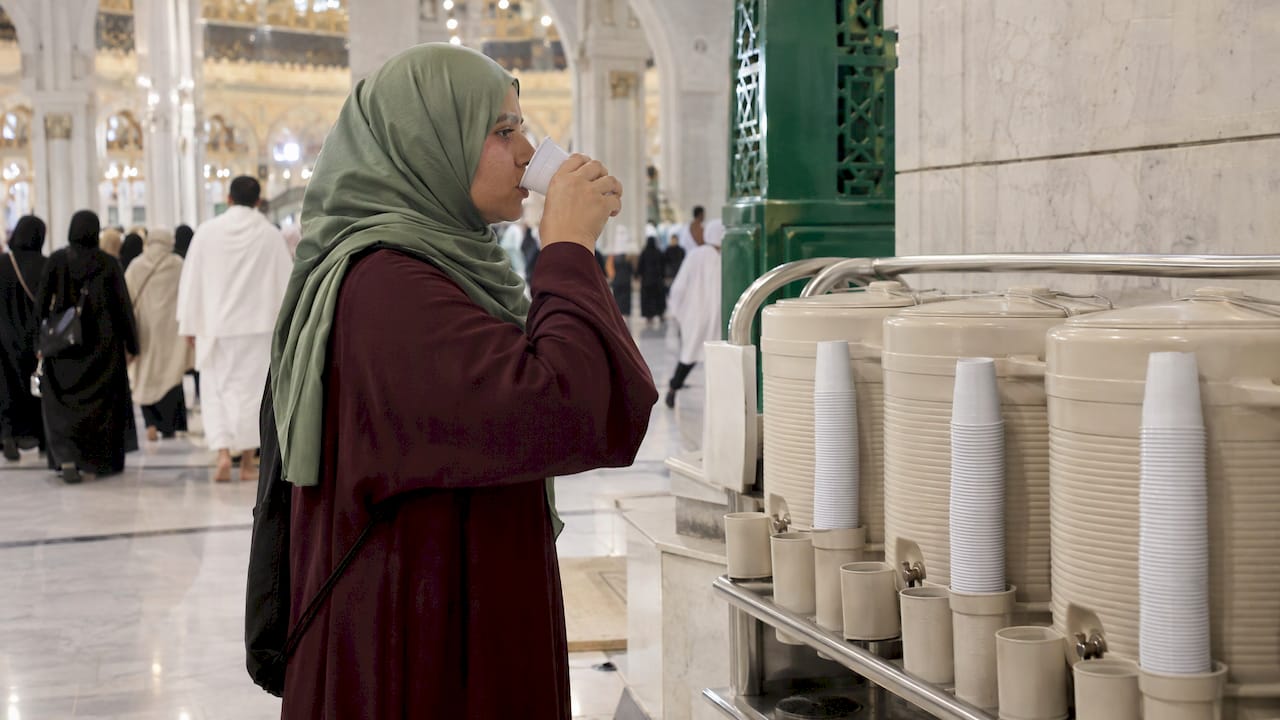
If someone performs Umrah for you or for a loved one, Zamzam belongs to that journey in two ways. The person performing the Umrah can drink it with a clear intention for the beneficiary. The family can also receive Zamzam water as a gift once it is brought home. What makes the Umrah itself count for the beneficiary is the intention made at ihram, and the name is a supporting detail. That is why a clear name, written in a form the representative can read, matters when you book a Badal Umrah.
This guide covers what scholars say about Zamzam and its purpose, how the beneficiary is named, and how to write a name so that it is understood.
TL;DR
- The hadith on Zamzam is general: it is for whatever purpose it is drunk for. Scholars recommend drinking it for a good in this world or the next.
- The Umrah itself is made for the beneficiary by intention in the heart at ihram. Saying the name aloud is preferable but not required.
- The wording is “Labbayk Allahumma 'an [name]”. If the name is forgotten, intending the Umrah for the person who sent the request is sufficient.
- Write the beneficiary’s name clearly, with the parent’s name if you wish, so the representative can say it correctly.
- Our packages start at $150 and include proof of completion with photos, videos and certificates.
Table of Contents
- What Zamzam means for the beneficiary
- How Zamzam is drunk with intention
- The intention is what makes the Umrah the beneficiary’s
- Writing a name for someone who does not read it easily
- Who can be the beneficiary
- Booking an Umrah in the beneficiary’s name
- Our perspective
- FAQ
- Sources
What Zamzam means for the beneficiary
The hadith most often quoted is that the water of Zamzam is for whatever it is intended for. Egypt’s Dar al-Ifta, the state fatwa body, says there is no objection in Islamic law to drinking Zamzam with the intention of seeking good in this world and the next. It also gives the wording of Ibn 'Abbas: whoever drinks it seeking healing, Allah heals him. Whoever drinks it for hunger, Allah satisfies him. Whoever drinks it for thirst, Allah quenches it.
This is the base of the practice. The water is drunk with a stated purpose. For a beneficiary, the purpose is often the acceptance of the Umrah, forgiveness for a deceased parent, or healing for someone who cannot travel.
Scholars read the hadith broadly. Ash-Shawkani, in Nail al-Awtar, holds that it covers all matters, worldly or of the hereafter, as Islamweb’s fatwa on drinking Zamzam for the benefit of another records. That is the reasoning behind drinking with a beneficiary in mind: the purpose of the drink is open, and a good wish for a parent, a spouse or a sick relative is a good purpose.
Zamzam is not a rite of Umrah
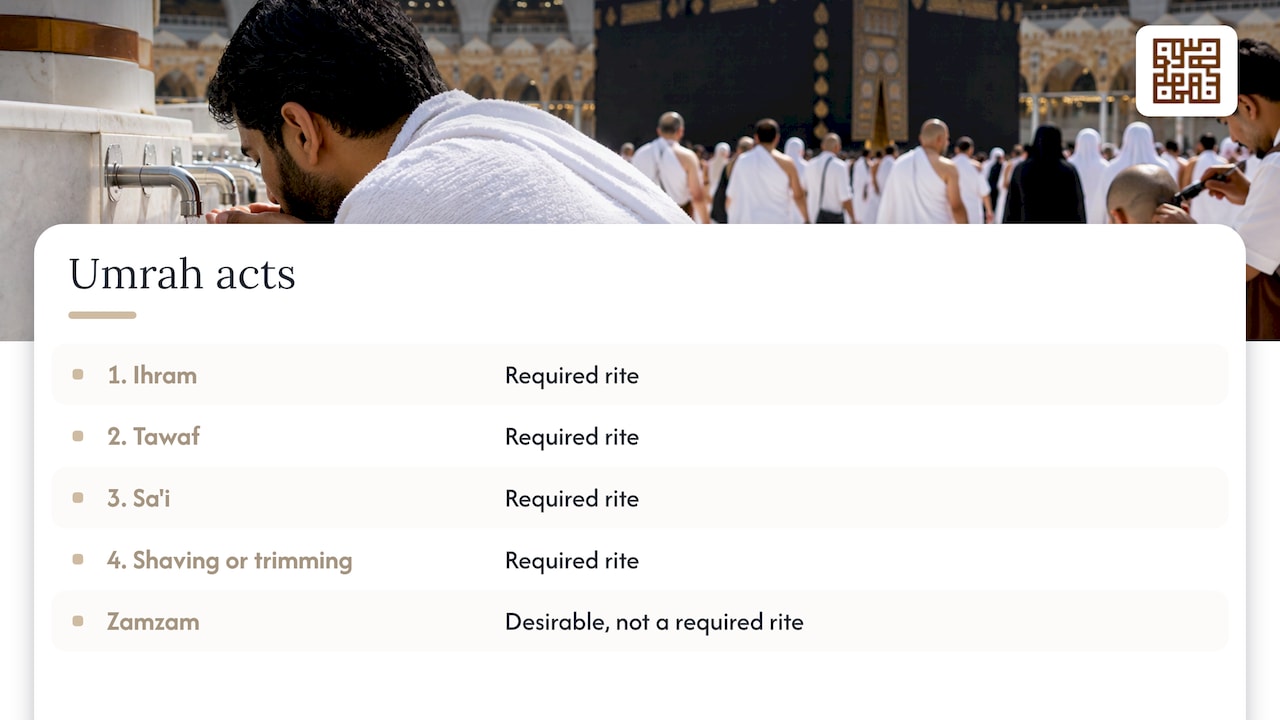
Zamzam is not one of the required acts of Umrah. Shaykh Ibn 'Uthaymeen explained that scholars differ on whether the Prophet’s drinking of it was an act of worship or a natural need. So it is not a specific legislated rite of Hajj or Umrah. He adds that drinking it is desirable in principle for purposes like quenching thirst, removing hunger or removing illness.
In practice, the Umrah is valid through its rites: ihram, tawaf, sa’i and the shaving or trimming of the hair. Zamzam is an act of blessing around them. Drink it with intention, and do not treat it as a condition.
How Zamzam is drunk with intention
The etiquette gathered in IslamQA’s article on the merits of Zamzam is simple:
- Face the Ka’bah.
- Say Bismillah.
- Drink in three breaths.
- Drink your fill if you can.
- Praise Allah when you finish.
- Make your du’a, naming the purpose you drink it for.
About drinking one’s fill: Islamweb rules that it is not a condition for the purpose to be achieved, since the hadith is general. See its ruling on drinking one’s fill of Zamzam. A small sip with sincere intention is enough.
A du’a for the beneficiary can be in your own words. Ask Allah to accept the Umrah from them, forgive them, heal them or raise their rank. It does not need to be long.
Zamzam as a gift
Giving Zamzam to the sick and to guests has precedent. IslamQA reports Aisha’s narration that the Prophet carried Zamzam away, poured it on the sick and gave it to them to drink. It also reports that Ibn 'Abbas honored guests by giving them Zamzam to drink. Some jurists therefore recommended taking it back to one’s country.
For a family waiting at home, this is a gentle way to receive a share of the journey. If you request Zamzam from the person who traveled, do so as a kindness between you, outside the Umrah itself.
The intention is what makes the Umrah the beneficiary’s
The key question for the beneficiary is not Zamzam but the niyyah, the intention. IslamQA, citing the Permanent Committee, rules that it is not essential to utter the name of the person on whose behalf Hajj or Umrah is performed. The intention in the heart suffices. It is preferable to say “Labbayk Allahumma 'an [name]” when beginning the Talbiyah.
Islamic Relief’s guide, reviewed by a mufti in April 2026, gives the same pattern: the intention is made when entering ihram, and the Talbiyah begins with the Umrah and the person’s name. See its Umrah guide. It also says one relative is named at a time.
If the name is forgotten, Ibn Baaz said it is sufficient to intend the rite for the one who gave the money, because actions are judged by intentions. This is the same page on IslamQA.
So the order is:
- Heart: the Umrah is for this person.
- Tongue: “Labbayk Allahumma 'an [name]” at the start of the Talbiyah, as the preferable wording.
- Zamzam: drunk afterward with a du’a for the same person.
We explain this in more detail in our guide to naming the beneficiary in Umrah.
Writing a name for someone who does not read it easily
Many families search for how to transliterate a name for Umrah. The person performing it may speak Arabic well, or may be a native speaker of Urdu, Bengali or Arabic. Your name may be written in English, Somali, Turkish or another script. A few habits help.
- Write the name in Latin letters as it is pronounced. Use the common spelling: Muhammad, Fatimah, Abdurrahman. If the name has a rarely seen spelling, add a plain-sound guide in brackets.
- Use the full name. Add the father’s or mother’s name if you wish, as in the Shubrumah hadith where the beneficiary was named. It avoids confusion between two people with the same given name.
- Do not translate meanings. Give the name, not what it means.
- Keep one beneficiary per request. Islamic Relief notes one relative at a time for a proxy Umrah. If you want to include several people, see our page on Umrah for multiple people.
- Add a short note on the relationship, such as mother, father or husband. It helps the representative form the intention correctly if the name slips from memory.
Because the name does not have to be uttered for the Umrah to be valid, a small error in pronunciation does not undo the rite. The intention carries it. A correct name is still a courtesy to the person you love.
Who can be the beneficiary
A proxy Umrah is for someone who cannot perform it themselves. Islamic Relief says it may be done for a relative who is deceased, chronically unwell or physically unable. For a living person, see our guide for permanently unable relatives.
There is also a condition on the performer. IslamQA states that the person performing Umrah for another must already have performed it for themselves, citing the hadith of the man who said “Labbayka 'an Shubrumah” and was told to do Hajj for himself first (Abu Dawud 1811, Ibn Majah 2903). The Shafi’i and Hanbali schools require this, while the Hanafi school holds that it is better but not required, according to Amalkit’s explanation of the schools. Our article on the proxy before their own Hajj goes into the views in detail.
If you wish to ask whether your situation qualifies, the right person is a scholar you trust or the imam at your local mosque. Our team can also walk you through the booking.
Gifting the reward as another path
The Hanafi school accepts that the reward of an act of worship can be gifted to the living and the dead. In this route, you perform an Umrah for yourself and give its reward to a parent, which differs from a proxy Umrah done in the beneficiary’s name. We cover the two ways side by side in Isal Thawab for Umrah. If the beneficiary is unable to travel and you want the rites performed in their name, the proxy Umrah is the way.
Booking an Umrah in the beneficiary’s name
When the person is deceased, old or ill, a family often cannot travel at once. Booking a Badal Umrah lets a trusted representative perform the rites for them. We offer a one-time fee with no recurring charges, and each package comes with proof of completion in the form of photos, videos and certificates.
| Package | Price | Page |
|---|---|---|
| Du’a Package | $150 | Du’a Package |
| Noor Package | $250 | Noor Package |
| Barakah Package | $400 | Barakah Package |
| Jariyah Premium Package | $500 | Jariyah Premium Package |
The packages differ in speed and features. Our work follows Islamic law and is verified by qualified imams, with updates and documentation as it goes. Dedicated customer support is there if you have a question about how to write the name.

If you are ready to name your loved one, start with the Du’a Package or choose the tier that suits your family at badalumrah.org. If you are weighing a payment ruling first, read paying someone for Badal Umrah.
Our perspective
A name is a small thing on a page, but to a family it is everything. We have built our service around that idea. The person who performs the Umrah holds the beneficiary in mind from the moment of ihram, and the family should be able to see that the rites were completed.
That is why each of our packages comes with documentation, photos, videos and a certificate, and why our work is verified by qualified imams. Zamzam is a blessing that surrounds the journey. The intention, the Talbiyah and the rites are what belong to the beneficiary.
We ask families to write the name with care, to tell us who the person is to them, and to make du’a for them. We take the rest on our side. A portion of our profits is pledged to charity, including support for Gaza, because we believe the reward of a good deed should reach further than one family.
anas
FAQ
Can Zamzam be drunk for another person?
The hadith is general, and Dar al-Ifta says there is no objection to drinking Zamzam with the intention of seeking good in this world and the next. Ash-Shawkani read it as covering all matters. Drink it with a clear du’a for the person you have in mind.
Do I have to say the beneficiary’s name aloud during Umrah?
No. The Permanent Committee’s ruling, as given on IslamQA, is that the intention in the heart is enough. It is preferable to say “Labbayk Allahumma 'an [name]” at the start of the Talbiyah. If the name is forgotten, intending the Umrah for the person who sent the request is sufficient.
How do I write my relative’s name for someone who does not speak my language?
Use the common Latin-letter spelling, add the parent’s name, and put a plain-sound guide in brackets if the spelling is unusual. A short note on the relationship also helps. Our guide to changing a beneficiary explains what to do if a name needs correcting.
Can the reward of Zamzam be sent to someone who has died?
Scholars recommend Zamzam for purposes of good in this world and the next, and the du’a for a deceased person is a good purpose. Ask a scholar you trust about the details for your school. The Umrah itself can be performed in the name of a deceased relative.
Is Zamzam part of the Umrah rites?
No. Ibn 'Uthaymeen explains it is not a specific rite of Hajj or Umrah, though drinking it is desirable. The rites that make the Umrah complete are ihram, tawaf, sa’i and the hair.
Sources
- Egypt’s Dar al-Ifta: drinking Zamzam with the intention of seeking blessings and healing
- IslamQA: Merits of Zamzam Water
- Islamweb: drinking Zamzam with the intention of benefiting another
- Islamweb: drinking one’s fill of Zamzam
- Al-Fatawa: is going to Zamzam among the acts of Hajj or Umrah
- IslamQA: it is not essential to mention the name of the person on whose behalf Hajj or Umrah is done
- Islamic Relief: how to perform Umrah
- Amalkit: can you do Umrah on behalf of someone else